
Vented vs Ventless Gas Logs: A DFW Buying Guide
How the two types of gas log differ on heat, looks, air quality and local rules, and which one suits a North Texas fireplace.
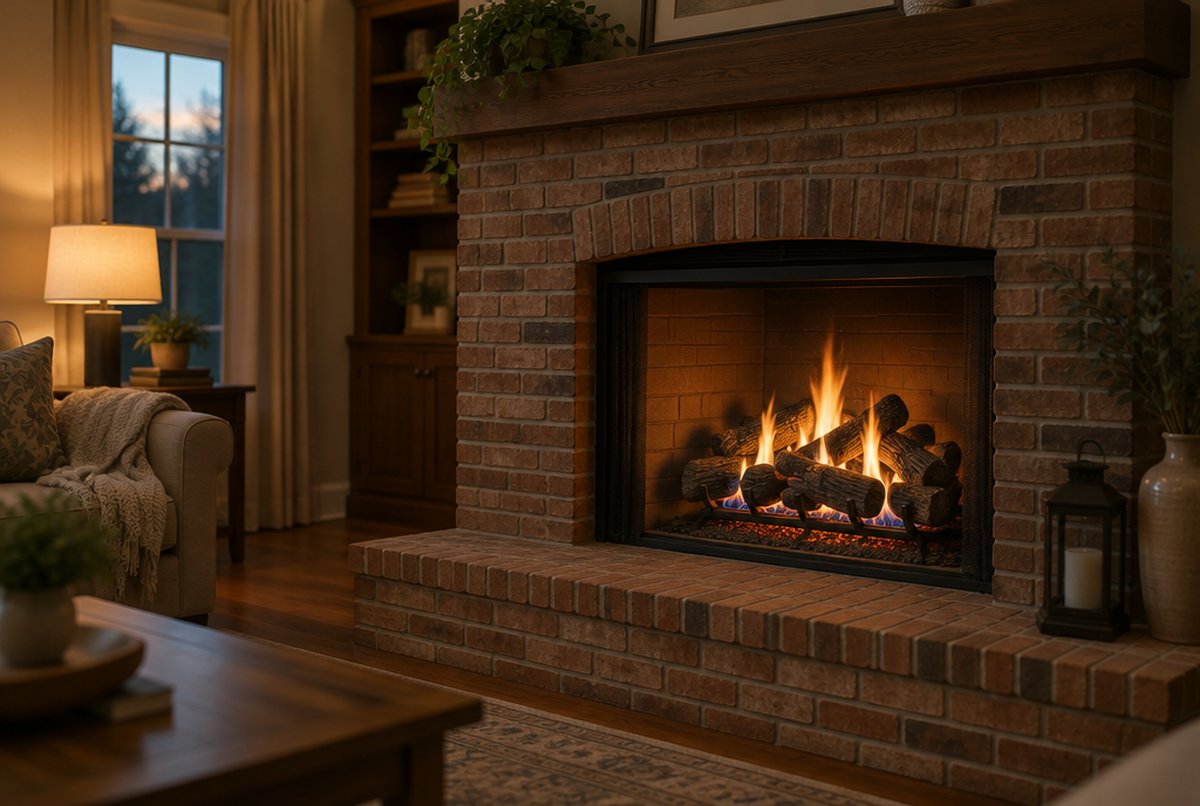
Vented gas logs need an open chimney and damper, burn a taller and more realistic flame, and send most of their heat up the flue. Ventless gas logs need no chimney, keep all of their heat and moisture in the room, and burn a shorter flame at up to 40,000 BTU. If you have a working masonry chimney, vented logs are usually the better fit for looks and indoor air. Ventless logs make sense for extra room heat where your city allows them. Whichever you choose, have the flue inspected before the logs go in and check local rules before you buy.
How the two types differ
Both kinds of gas log are ceramic or refractory pieces shaped like wood that sit over a gas burner in a fireplace. The difference is where the exhaust goes. A vented set is designed to burn with the flue open, so the combustion gases, including carbon monoxide, rise up the chimney and out of the house. A ventless set, also sold as vent-free or unvented, uses a special burner that burns the gas more completely and an oxygen depletion sensor that shuts the gas off if the room air gets too low in oxygen. It does not need a chimney at all, which is why it can go into a wood-burning fireplace or a prefabricated unit.
That one design choice drives almost everything else you will notice: how the fire looks, how much heat reaches the room, what the air in the room is like, and whether a building department will let you install it.
Heat: vented logs lose most of it up the chimney
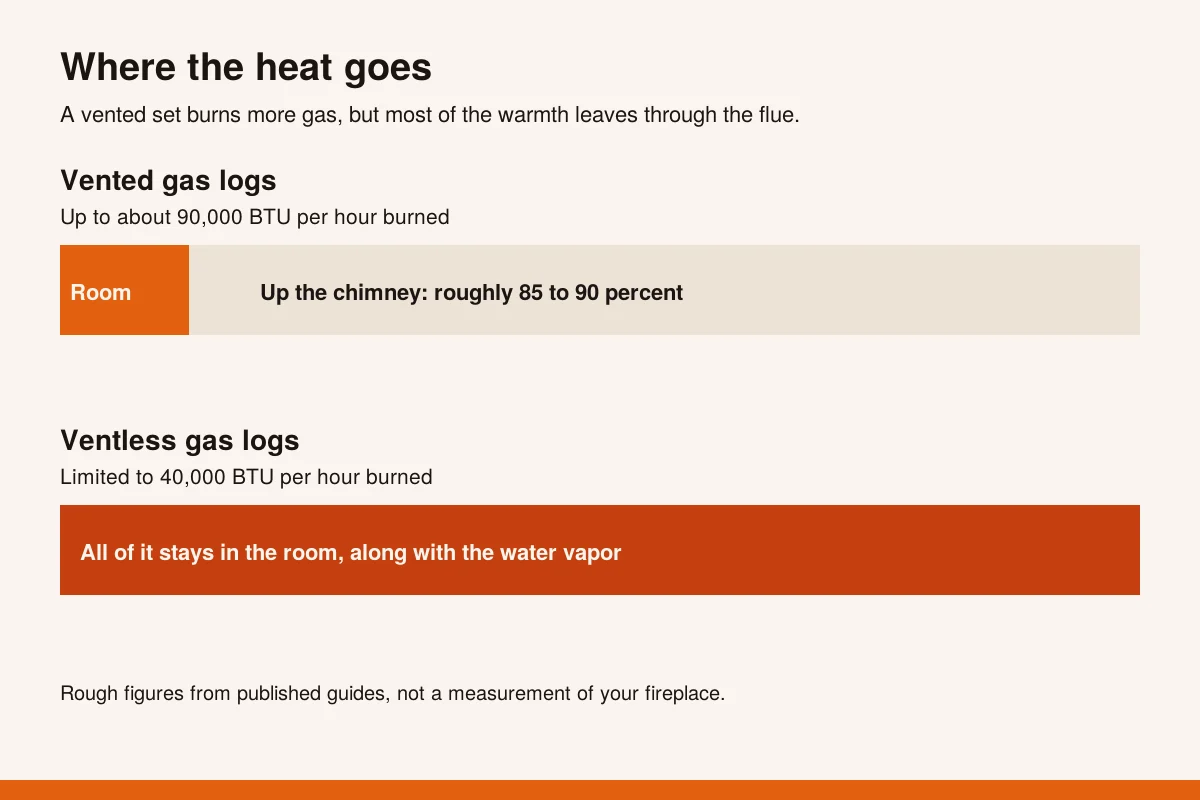
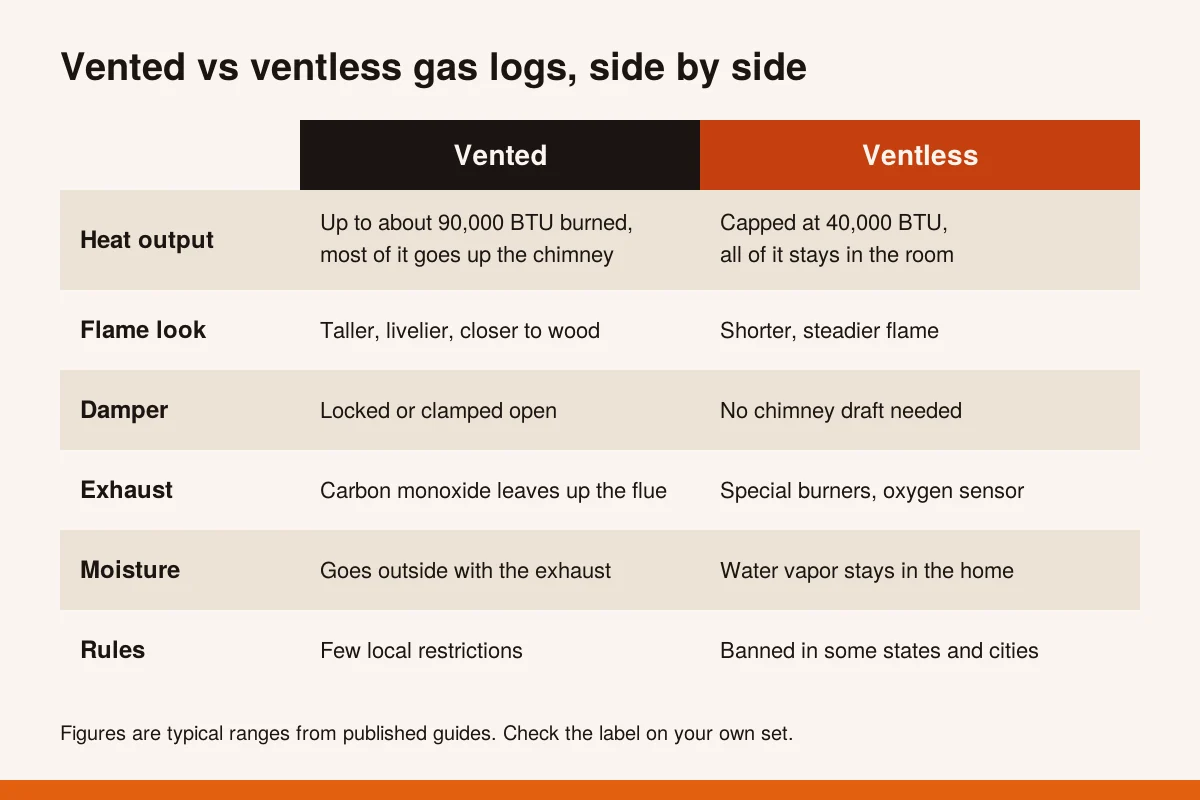
Vented logs can burn up to about 90,000 BTU per hour, which sounds like a lot of heat. Published guides estimate that roughly 85 to 90 percent of it travels up the chimney instead of into the room. You get the glow and a little warmth near the hearth, but a vented set is not a real heat source, and it uses more gas to produce what it does give you.
Ventless logs are capped at about 40,000 BTU per hour, but all of that stays in the house. They can warm a room noticeably and some people use them as a backup during a power outage. That heat comes with a trade-off, which is the water vapor and combustion byproducts that stay in the room with it.
Looks: vented logs burn closer to wood
If you want the fire to look like a fire, vented logs win. Because they have a chimney pulling the exhaust away, they can burn a taller, lazier, yellow flame that moves like a wood fire, and the embers under the logs glow more convincingly. Ventless burners keep the flame shorter and steadier on purpose, so the fuel burns clean and the oxygen sensor is not tripped. Many people find the result a little flat next to a vented set, though modern ventless logs are better looking than they used to be.
Vented sets also tend to cost less than ventless sets, according to retailer buying guides, and installation is simple when a working fireplace is already in place.
Air quality and safety
A vented set puts its exhaust outside, so the air in the room stays about as it was. The one rule that matters is the damper. A vented set has to burn with the damper locked or clamped open the entire time, because a closed damper pushes carbon monoxide back into the house. That is also why a vented set should never be paired with a chimney that has not been checked. A blocked flue, a cracked liner or a bird nest will send the exhaust somewhere you do not want it.
Ventless logs burn almost all of their fuel and produce very little carbon monoxide, and AGA-certified sets include the oxygen sensor described above. They still release water vapor and small amounts of combustion byproducts into the room. In an older, drafty house that moisture is rarely a problem. In a newer, tightly built home it can show up as condensation on cold windows, and over time as dampness in walls or the attic. Some people notice an odor or throat and eye irritation, and anyone with asthma, severe allergies or lung conditions has more reason to be cautious. Burning the fire for an hour or two at a time and cracking a window if you run it longer is a common precaution.
A carbon monoxide detector on every level is a good idea with either type, and the logs and burner should be installed by a licensed technician following the maker's instructions to the letter.
Texas and local code
Ventless logs are not legal everywhere. California bans them, and so do several other states, including Massachusetts, Minnesota, Montana, New York, Utah and Alaska. Texas is not on those lists, but cities and counties set their own building rules, and some municipalities restrict or prohibit unvented appliances. Dallas, Fort Worth and the surrounding suburbs do not all read the code the same way, so the safe move is a short call to your city's building department before you buy a ventless set. Your insurer may also have a view, so it is worth asking.
There are other practical limits. Every ventless set has a maximum size and a minimum clearance to the walls and mantel of the firebox it goes into, and many have limits on use in bedrooms and bathrooms. Those limits are written on the label for a reason, and a set that does not match the firebox is a problem even if the code allows it.
Which one fits your fireplace
Start with the fireplace you have. A masonry fireplace with a sound flue and a damper that locks open is a natural home for vented logs. If you are not sure whether your chimney is masonry or a factory-built prefab unit, how to tell which chimney you have walks through it, and the answer affects what you can install.
Vented logs go in best when the chimney draws well. If your fireplace has ever smelled or smoked, read chimney draft explained first, because a weak draft is the one thing that can make a vented set unsafe.
Ventless logs are the better fit when the chimney is in poor shape and you are not planning to repair it, when you want the heat to stay in the room, or when the fireplace is a prefab unit rated for them. They are not a way to get around a chimney problem. A fireplace that leaks water or has a cracked flue still needs attention, and if you plan to convert a wood-burning fireplace permanently, converting a wood fireplace to gas in DFW covers the options and the gas line side of it.
If you cannot decide, a practical rule is this. When your main goal is a good-looking fire and you have a working chimney, choose vented. When your main goal is heat, you have no usable flue, and your city allows it, a ventless set is worth a look.
Get the chimney checked before you install either
Whichever way you lean, the chimney should be inspected and cleaned before gas logs go in. A fireplace that burned wood for years usually has creosote and soot in the flue, and a flue that has not been looked at may have a damaged liner, a missing cap or an animal nest. A vented set depends on that flue to carry the exhaust out, so it has to be clear and in one piece. Even a ventless set sits in a firebox that should be sound, with a crack-free floor and walls.
Our fireplace repair page covers firebox and gas fireplace work, and chimney liner installation explains what happens when the flue needs a new lining. Once the logs are in, the set needs its own yearly attention. Gas fireplace maintenance: what it needs and how often lists what a yearly visit covers, and gas fireplace inspection: what a technician actually checks shows what a technician looks at on the gas side.
A few mistakes to avoid
The most common problem is putting a ventless set into a firebox it was not sized for, so it sits too close to the walls or sooty because the flame touches the logs. The second is running a vented set with the damper closed, which is dangerous and easy to do by accident if the damper is not clamped. The third is treating the choice as permanent. Logs can be swapped, but a set that was bought without checking local rules can mean paying twice.
It is also worth knowing that a vented set and a ventless set are not interchangeable in the same firebox without checking the instructions. The makers write the limits, and an installer who follows them will keep you inside the warranty and the code.
Not sure which gas logs your fireplace can take?
We check the flue, the firebox and the gas line before anything goes in, and we tell you plainly whether vented or ventless is the safer fit for your fireplace. The estimate is written and itemized, and nothing starts until you approve it. Based in Plano, working across DFW since 2013.
Common questions about vented and ventless gas logs
Are ventless gas logs safe?
Certified ventless sets have an oxygen depletion sensor and burn cleanly, but they release water vapor and some combustion byproducts into the room. Use a carbon monoxide detector, follow the label limits and have a technician install the set.
Do vented gas logs give off heat?
A little. Published guides estimate that roughly 85 to 90 percent of the heat goes up the chimney, so a vented set is mostly for the look of the fire.
Are ventless gas logs legal in Texas?
Texas does not ban them statewide, but cities set their own building rules. Call your local building department before buying a ventless set.
Can I leave the damper closed with gas logs?
Not with vented logs. The damper has to stay locked or clamped open whenever the logs burn, or carbon monoxide can enter the house.
Do I need a chimney inspection before installing gas logs?
Yes. A blocked or damaged flue is dangerous with vented logs, and the firebox should be sound with either type.