
Converting a Wood Fireplace to Gas in DFW
Three ways to switch, what each costs and what your chimney has to pass first.
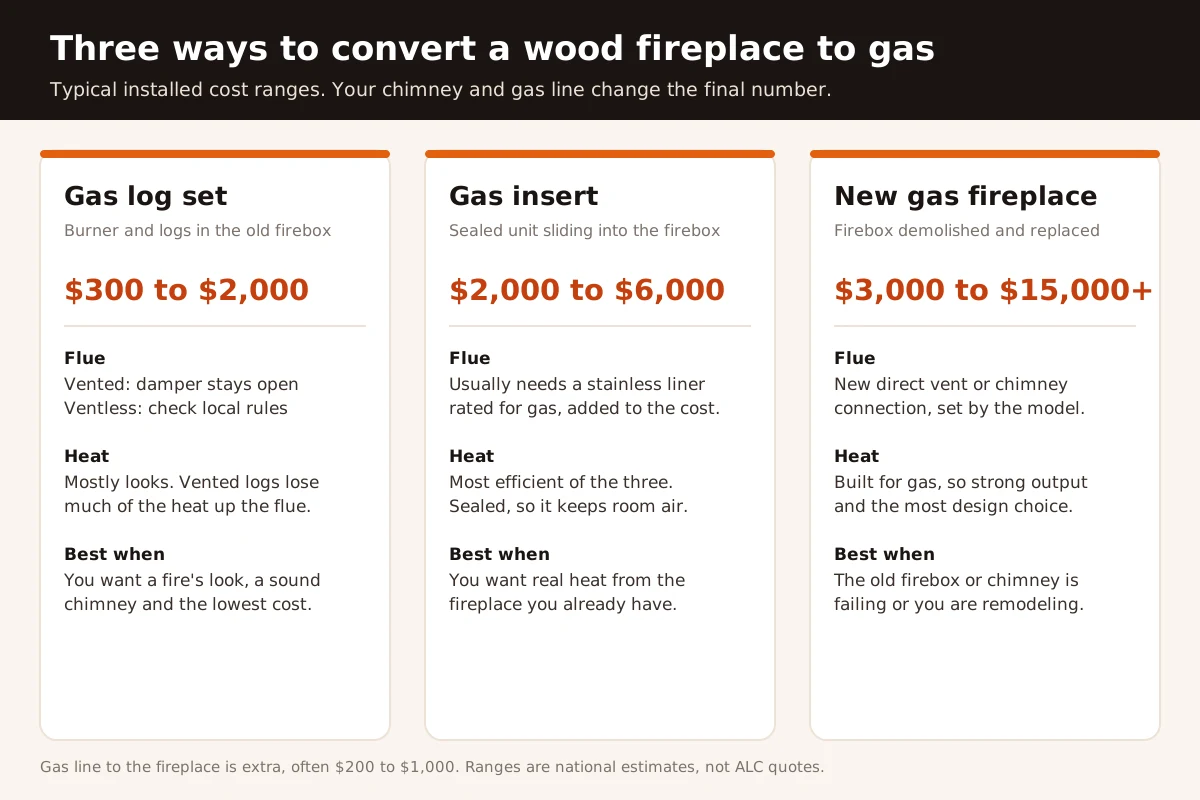
Yes, most wood fireplaces in North Texas can be converted to gas, and there are three ways to do it. A gas log set dropped into the existing firebox runs about $300 to $2,000 installed. A sealed gas insert costs roughly $2,000 to $6,000 and usually needs a stainless liner. Tearing out the firebox for a new gas fireplace starts near $3,000 and can pass $15,000. A gas line to the hearth adds roughly $200 to $1,000 on top of any of them. The cheapest route is the one your chimney can safely support, so the first step is an inspection of the flue, not a trip to the showroom.
What converting a fireplace to gas actually means
People use the word conversion for three different jobs. One is a burner and a set of ceramic logs sitting in the firebox you already have. Another is a sealed gas appliance that slides into that same opening. The third is removing the old firebox and building something new. They share one trait: none of them turns a wood-burning chimney into a gas chimney without checking the flue first. Gas combustion makes less soot than wood, but it still sends heat, water vapor and acidic byproducts up the stack, and a cracked clay liner does not care what fuel is under it.
In DFW the usual reasons we hear are convenience and cleanup. You flip a switch on a cold November night instead of hauling wood, and there is no ash to scoop out in the morning. The usual worry is the opposite: that the fire will look fake or throw no heat. Which route you pick decides both.
Route 1: a gas log set in the existing firebox
A burner pan, a gas supply and a set of ceramic or refractory logs go into your open firebox. It is the least expensive conversion and the least disruptive, since the masonry stays as it is. Installed cost generally lands between $300 and $2,000, with vented sets and any new gas line work pushing toward the top of that range.
The choice inside this route is vented or ventless. Vented logs make a taller, more natural flame and send all the exhaust up the chimney, so the damper has to stay open whenever the fire is on, and installers normally secure it open so nobody closes it on a lit burner by accident. Most of the heat goes up the flue with the exhaust, so this is a fire to look at more than a way to warm the room. Ventless logs burn hotter and keep their heat in the room, but their combustion products stay in your air too. Some cities and states restrict them, and manufacturers say they should never be the main heat for a room that is not sized for them. Ask your city building office what it allows before you buy a ventless set, and put a carbon monoxide alarm near any gas appliance either way.
Route 2: a gas insert
An insert is a sealed firebox with its own glass front that slides into your existing opening and connects to the chimney through a liner. Because it is sealed, it does not pull heated room air up the flue the way an open fire does, which is why it is the most efficient of the three routes. Expect roughly $2,000 to $6,000 for the unit and installation, and more for larger or high-end models.
The liner is the part people do not expect. Most direct vent inserts send exhaust up a stainless steel liner run through the old flue, and national estimates for that liner run from about $900 to $3,800 depending on chimney height and liner type. Our chimney liner installation page explains what we install and how we size it, and the right size depends on the appliance, not just the chimney. A flue that was sized for a big wood fire is often far too large for a small gas unit, which is covered in our guide to chimney flue size.
Route 3: a new gas fireplace
This is a full replacement. The old firebox comes out, a factory-built gas unit goes in, and the surround is rebuilt around it. Costs start near $3,000 and can run past $15,000 once framing, finish work and a new vent are included. The reason to choose it is a failing firebox or a remodel already in progress. If the brick is cracked, the throat is damaged or the layout never worked, spending on a conversion that keeps those problems makes little sense. Our plain English map of the fireplace shows which parts matter in that decision.
What each part of the job costs
These are typical national ranges. DFW quotes vary with the age of the house, chimney height and how far the gas line has to travel.
| Item | Typical range | Notes |
|---|---|---|
| Gas log set, installed | $300 to $2,000 | Vented sets and new gas line work sit at the high end |
| Gas insert, installed | $2,000 to $6,000 | Larger and premium models cost more |
| New gas fireplace | $3,000 to $15,000+ | Includes demolition and rebuilding the surround |
| Gas line to the hearth | $200 to $1,000 | Depends on distance from the nearest supply |
| Stainless liner for gas | $900 to $3,800 | Most inserts need one |
| Chimney inspection and sweep | $100 to $600 | Ahead of any conversion |
| Permit | Often $50 to $200 | Set by your city |
Sources for the ranges include Valor and HomeAdvisor. Where they disagree, the table uses the wider range.
Gas lines, permits and who does the work
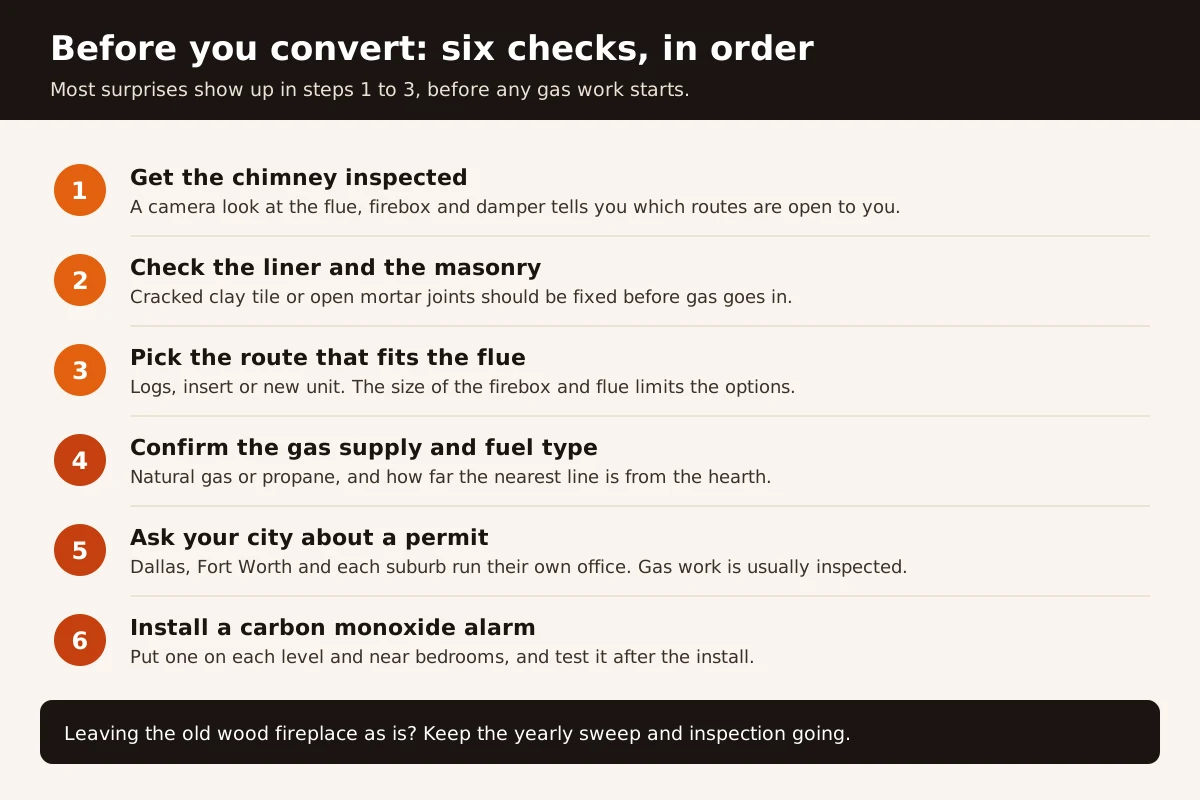
The gas supply is the piece to settle early. If a gas line already runs to the fireplace, the job gets cheaper and simpler. If it does not, someone has to bring one from the nearest supply, sometimes through a wall or under a floor. That is work for a licensed professional, and it is where many cities want a permit and an inspection after the work is done. Dallas, Fort Worth and every suburb around them run their own building offices, so call yours before you sign anything. Also confirm whether your home runs on natural gas or propane, because each appliance is built for one fuel. For much of DFW the gas utility is Atmos Energy, and your gas meter location tells you a lot about how far the line has to run.
We handle the chimney side: inspection, liners, caps and masonry repair. The gas line and the appliance hookup belong to a licensed plumber or gas fitter, and a good installer will want to see the inspection results before ordering anything.
Does your chimney need work first?
Often it does, and finding out before the install saves money. A camera inspection checks the clay tile liner for cracks, the mortar joints, the damper and the crown. Cracked tile or open joints should be repaired before gas goes in, because gas exhaust is acidic and wet and attacks weak masonry. A missing or damaged cap lets rain and animals into a flue you now plan to use again. Our fireplace repair team works on both gas and wood fireplaces across Dallas and Fort Worth, and our gas fireplace inspection checklist shows what a technician looks at once the unit is running.
What you give up when you go gas
You lose the crackle, the smell and the sense that you built the fire yourself. You also lose the ability to burn when the gas is off. After the February 2021 freeze, plenty of North Texans learned the value of a fireplace that works without power. Many gas log sets and standing-pilot systems run with no electricity, while units with fans or electronic ignition need power or a battery backup. If outages worry you, ask about that before you pick a model.
On the other side, gas gives you no creosote, no ash and no wood stack. It does not remove the need for service, though. The burner, pilot, thermocouple and glass still need yearly attention, and the flue still needs inspecting. Our gas fireplace maintenance guide covers what that looks like each year.
Which route fits which house
If the chimney is sound and you mainly want the look of a fire without the work, a gas log set is the practical choice. If you want real heat from the fireplace you already have, and the flue can take a liner, an insert earns its higher price. If the firebox is cracked, the layout is wrong or you are already remodeling the room, a new gas fireplace gives you a clean start. In a house where the fireplace gets used a handful of times each winter, as many do in North Texas, the cheapest route that is installed safely usually makes the most sense. Efficiency gains take years to repay when the heating season is short.
Keeping the wood fireplace instead
Gas is not the answer for everyone. If you like burning wood and the chimney is in good shape, a yearly sweep and inspection keeps it safe, and chimney sweep and cleaning starts at $99 with the inspection included. The final price depends on the chimney type, access and how much buildup there is.
Thinking about converting? Start with the flue.
We inspect the chimney, show you photos of what we find and tell you which conversion routes it can handle. Based in Plano, working across DFW since 2013.
Common questions about converting to gas
Can you convert a wood burning fireplace to gas?
Yes, in most cases. The three routes are a gas log set, a gas insert and a new gas fireplace. A chimney inspection comes first, because the flue condition decides which routes are safe.
How much does it cost to convert a wood fireplace to gas?
Typical ranges are $300 to $2,000 for gas logs, $2,000 to $6,000 for an insert and $3,000 to $15,000 or more for a new gas fireplace. A gas line adds roughly $200 to $1,000 and a liner roughly $900 to $3,800.
Do I need a permit to convert to gas?
Most cities want a permit and an inspection for gas line work. Dallas, Fort Worth and each suburb set their own rules, so call your building office before work begins.
Do gas logs need the damper open?
Vented gas logs do. The exhaust goes up the chimney, so the damper must stay open while the fire burns. Ventless logs do not use the flue, but some areas restrict them.
Does a gas fireplace still need a chimney sweep?
It needs an inspection and service each year, though less soot removal. The flue, cap and burner still need checking.