
Chimney Draft Explained: Stack Effect, Flue Size and Cold Hearths
The physics behind why chimneys draft, why some fight you every time, and how to tell a real sizing problem from an ordinary cold start.
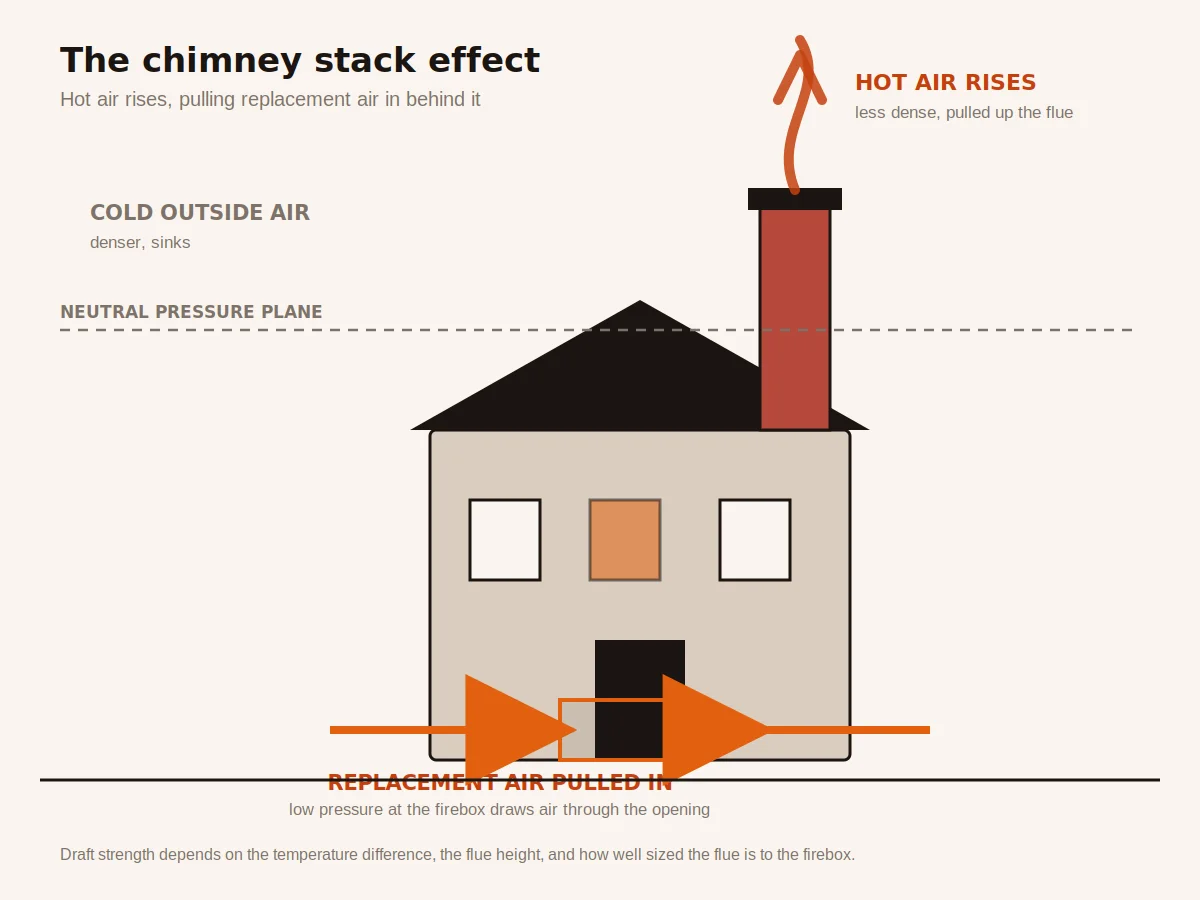
Chimney draft is the natural upward pull of air through your flue. It happens because hot air is lighter than cold air, so as heat rises up the chimney it lowers the pressure at the firebox and pulls in fresh combustion air to replace it, which is what keeps smoke going up and out instead of curling back into the room. Good draft depends on three things working together: enough temperature difference between the flue and the outside air, a flue sized correctly to the fireplace opening below it, and enough replacement air available inside the house. In North Texas, most draft complaints trace back to one of those three: a flue that is the wrong size for the firebox, a cold chimney that was never warmed before lighting, or a tightly sealed house competing for air with kitchen and bathroom exhaust fans.
The stack effect, in plain terms
Every working chimney runs on the same basic physics, called the stack effect. Air inside a hot flue is less dense than the cold air outside, so it rises, the same way a hot air balloon does. As that column of warm air moves up and out of the flue, it creates a small drop in pressure at the firebox, and outside air rushes in through the fireplace opening to fill the gap. That inward rush is what carries smoke up with it instead of letting it drift into the living room. The taller the flue and the bigger the temperature difference between inside and outside, the stronger that pull. A short flue on a mild fifty degree evening, which describes a lot of North Texas nights, simply does not generate as much draft as a tall flue on a freezing one, and that is ordinary physics, not a broken chimney.
Draft is not an on-or-off switch either. It builds gradually as the flue warms, which is why a fire often smokes for the first few minutes and then clears once the masonry or metal liner heats up enough to sustain a strong column of rising air.
Why chimney draft fails: the four real causes
When a fireplace smokes, drafts poorly, or seems to fight you every time you light it, the cause almost always falls into one of four categories.
A flue that is the wrong size for the firebox
A flue that is too small for the fireplace opening below it cannot move enough air, so smoke backs up into the room under normal conditions, not just in a strong wind. A flue that is too large for the opening has the opposite problem. It cools the rising gases too much before they clear the top, which weakens the draft and gives creosote more chance to condense on the way up. Sizing has to match the opening, not just look proportional to it.
A cold flue that was never warmed up
A flue that has sat cold for days, especially one running through an unheated attic chase, starts a fire at a disadvantage. The air sitting inside it is the same temperature as the room, so there is no pull yet, and the first few minutes of smoke are often just the chimney catching up to the fire.
The house is competing for the same air
Modern homes are sealed tighter than older ones, and every exhaust fan, a kitchen range hood, a bathroom vent, a whole-house ventilation system, pulls air out of the house. If there is nowhere else for replacement air to come from, the fireplace becomes the path of least resistance and draft can reverse, pulling smoke into the room instead of pushing it out.
Wind, terrain and nearby structures
A chimney positioned near a taller roofline, a stand of trees, or a two-story addition can sit in a wind eddy that pushes air down the flue instead of letting it rise. This kind of downdraft tends to show up on windy days specifically, which is one of the clues that separates it from a sizing problem.
Getting the flue size right
Masonry fireplace sizing follows a simple, long-standing ratio. For a flue fifteen feet or taller, measured from the fireplace throat to the top of the chimney, the flue's cross-section area should be at least one tenth the area of the fireplace opening. For a shorter flue, under fifteen feet, that ratio increases to one eighth, since a shorter column of rising air needs more room to move the same volume of smoke. A flue built smaller than that ratio will struggle no matter how well the fire is built or how warm the chimney gets.
| Flue height | Minimum flue area |
|---|---|
| 15 feet or taller (throat to chimney top) | At least 1/10 of the fireplace opening area |
| Shorter than 15 feet | At least 1/8 of the fireplace opening area |
Prefab, metal-lined fireplaces work differently. Their flue is sized by the manufacturer to the specific unit, so there is no ratio to calculate by hand, but a mismatched replacement liner or an incorrectly sized insert dropped into an existing flue can throw that balance off just the same way an undersized masonry flue does.
Priming a cold flue before you light it
Because a cold flue has no draft to start with, the fix is to warm the air inside it before the main fire gets going, a step chimney sweeps call priming. Twist a few sheets of newspaper into a loose stick, hold the lit end up near the damper opening for thirty seconds to a minute, and let the rising heat start the air moving before building the actual fire. It sounds like an old trick, and it is, but it works because it addresses the real physics: it warms the column of air enough to establish the first pull of draft, so the real fire is not fighting a dead-cold chimney from the first match.
This matters more in North Texas than it does further north, precisely because fireplaces here often sit unused for weeks between the occasional cold snap. A chimney that gets lit every night through a long winter rarely fully cools between fires. One that gets lit three or four times a season starts cold every single time.
Cold hearth syndrome in North Texas homes
Cold hearth syndrome describes a fireplace that will not draft at all on the first try, even with good kindling and technique, because the flue is not just cool but close to the same temperature as a cold night outside, sometimes colder than the room air around it. It shows up most in homes with a chimney running up an exterior wall or an unheated chase, and in newer, tightly built houses where there is little natural air leakage to help balance pressure. Priming the flue is the first fix. If that alone does not solve it, the more likely explanation is one of the other causes above working alongside it, usually a house that is too tightly sealed for the fireplace to compete for air.
Is this a sizing fault, or something else? A quick way to tell
Not every draft problem needs a resized flue, and telling the difference saves a repair that will not fix anything.
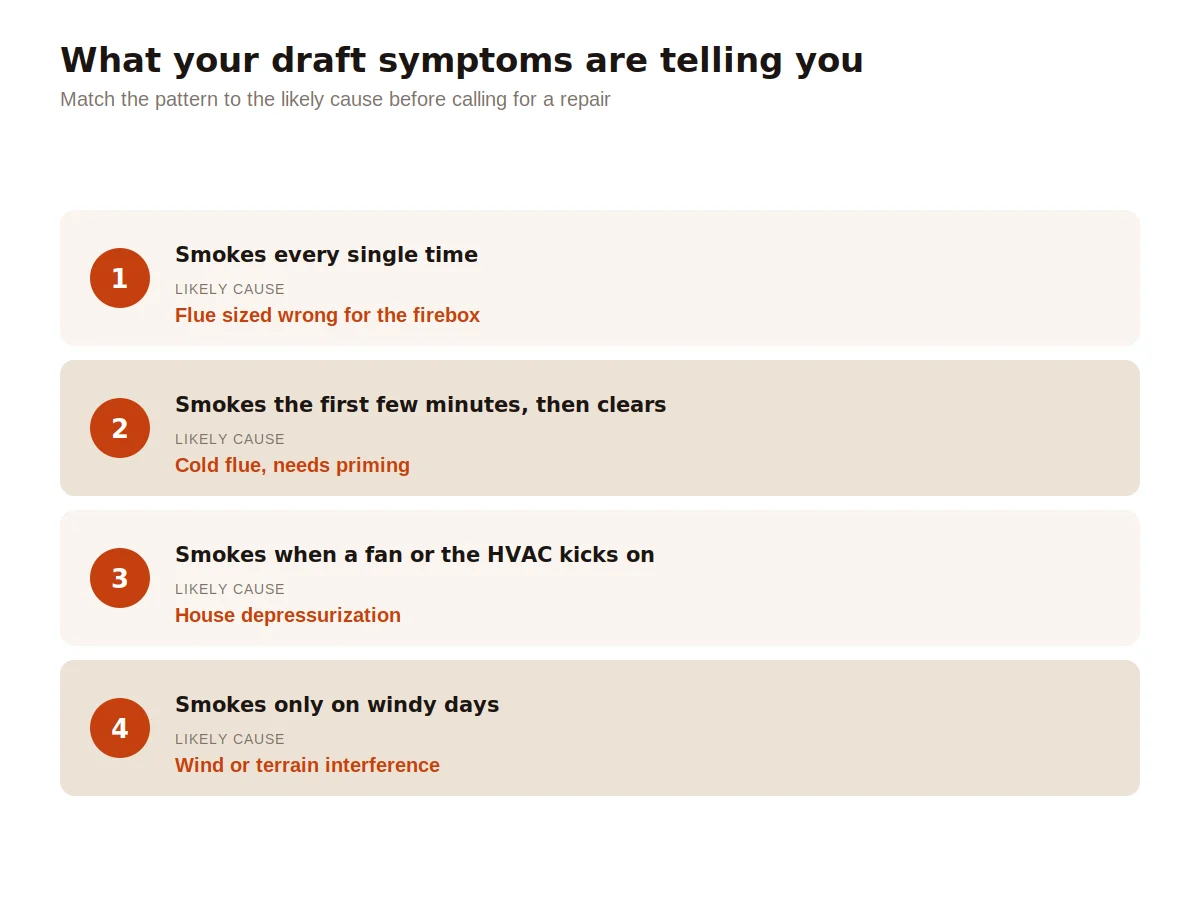
If the fireplace smokes every time it is used, regardless of wind, weather or whether other fans are running, and it has smoked that way since the day you moved in, that points toward a mismatch between the flue and the opening, or a flue that is too short for its surroundings. That is a structural issue that needs a technician's measurement, not a habit change.
If the fireplace usually drafts fine but smokes on windy days specifically, that points toward terrain or wind interference rather than sizing. If it drafts fine until the exhaust fan or the HVAC system kicks on, that points toward house depressurization, which is solved with a cracked window or a dedicated air supply, not a new flue. And if it only misbehaves for the first few minutes of a fire and then clears, that is an ordinary cold start, not a fault at all.
Fixing draft that will not cooperate
When the cause turns out to be structural, the fix depends on what is actually wrong. A flue that is genuinely undersized for its fireplace sometimes needs a correctly sized liner rather than a patch. A chimney that sits too low relative to the roofline or nearby trees can often be resolved by extending its height, following the standard rule that a chimney should clear the roof ridge, or anything within ten feet of it, by at least two feet. A missing or poorly fitted cap can also worsen a marginal draft by letting wind hit the flue opening directly instead of being deflected. None of these are homeowner fixes, since getting the measurement wrong just trades one draft problem for another.
Our chimney services team measures the actual flue and opening before recommending anything, and our fireplace repair techs handle the gas-side issues, like a damper that will not seat or a pilot that will not hold in a downdraft, that can look like a draft problem but are not. If the chimney has not been swept in a while, that is worth ruling out too. We cover how often that should happen in our North Texas cleaning frequency guide, since a flue narrowed by heavy creosote buildup can mimic a sizing problem that a rebuild will not actually fix.
Not sure if your draft problem is sizing, a cold flue, or something else?
We will measure it, tell you plainly what we find, and fix what is actually wrong. Based in Plano, working across DFW since 2013.
Common questions about chimney draft
What is the chimney stack effect?
It is the physics that makes a chimney work. Hot air inside the flue is lighter than the cold air outside, so it rises, lowering pressure at the firebox and pulling in fresh air to replace it. That inward pull is what carries smoke up and out instead of into the room.
Why does my fireplace only smoke on windy days?
That pattern usually points to wind or terrain interference rather than a sizing problem. A chimney positioned near a taller roofline, trees, or a second story addition can sit in a wind eddy that pushes air back down the flue on gusty days while drafting normally the rest of the time.
How do I prime a cold chimney before lighting a fire?
Twist a few sheets of newspaper into a loose stick, hold the lit end near the damper opening for thirty seconds to a minute, and let the rising heat warm the air in the flue before building the real fire. It establishes the first pull of draft so the fire is not starting against a dead-cold chimney.
Can a chimney flue be too big, not just too small?
Yes. An oversized flue cools the rising smoke too much before it clears the top, which weakens draft and encourages creosote to condense on the way up. Flue size needs to match the fireplace opening on both ends, following the one tenth or one eighth ratio depending on chimney height.
Does a missing or damaged chimney cap affect draft?
It can. A cap deflects wind away from the flue opening. Without one, or with one that fits poorly, wind can hit the opening directly and push air back down the chimney, especially on a marginal flue that was already struggling to draft well.