
Gas Fireplace Inspection: What a Technician Actually Checks
The checklist in the order it is worked, what fails most often and what an inspection costs in DFW.
A gas fireplace inspection is a technician's walk through every part that keeps the flame burning safely: the gas connections tested for leaks, the pilot and thermocouple, the burner, the glass and door seal, the venting, the controls and a carbon monoxide reading. Expect to pay roughly $100 to $200 for an inspection on its own, and a combustion and CO test adds about $40 to $75 to a $120 to $225 DFW tune-up. The parts that fail most often are the pilot assembly, the thermocouple, the igniter and the door gasket. Book it once a year, ideally in early fall before the first cold night.
What a gas fireplace inspection is, and what it is not
An inspection is a look and a test. The technician checks that the fireplace is safe to run, finds anything worn or failing, and tells you what they saw. A tune-up goes a step further and cleans the burner and resets the logs. A repair fixes a specific fault. Most DFW service calls bundle the first two, but they are not the same thing, and knowing the difference helps you read a quote. Our guide to gas fireplace maintenance covers the cleaning and upkeep side. This page is about the inspection itself.
What gets checked depends on the unit. A sealed direct-vent fireplace, a vent-free insert and a gas log set burning inside an old masonry firebox all fail in different places, and the technician adjusts the list to match. The order below is the one most crews follow because the safety items come first.
The checklist, in the order a technician works through it
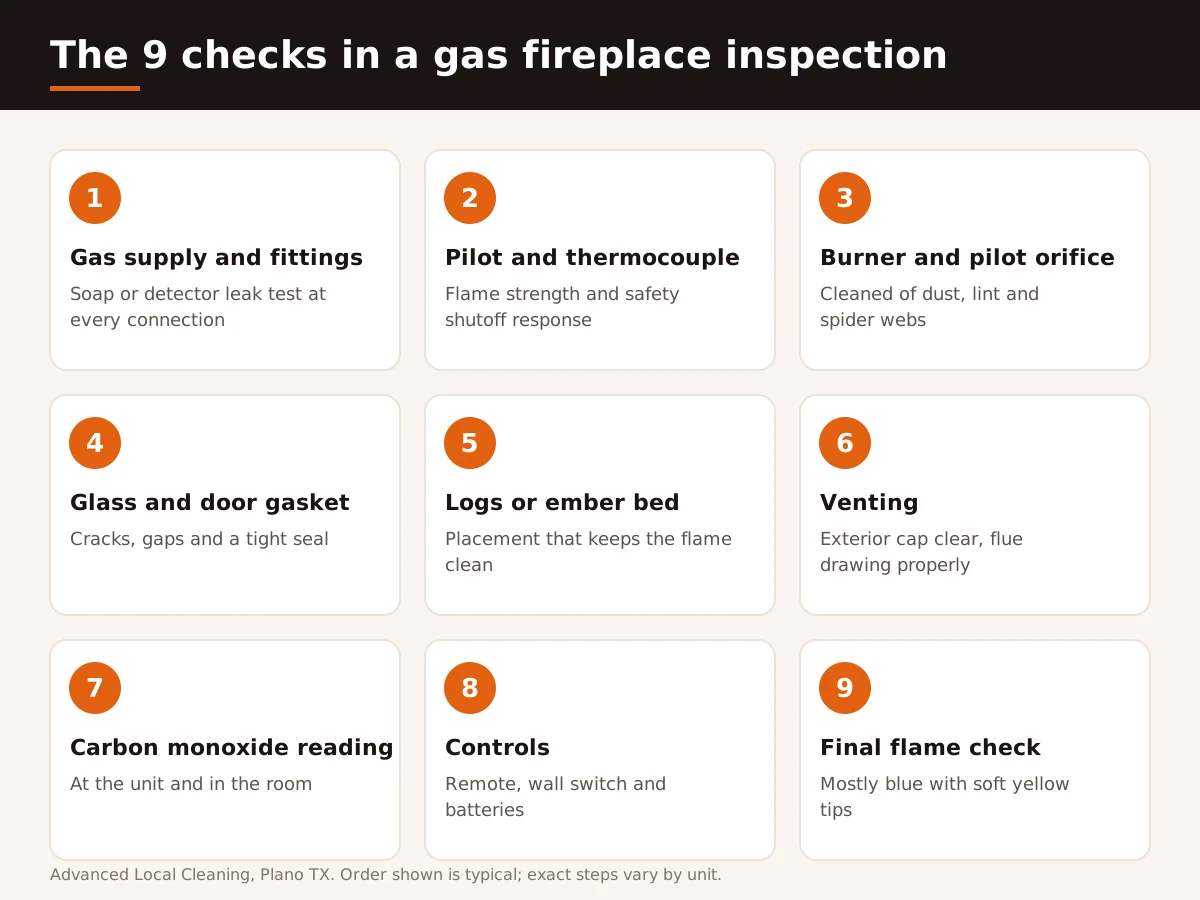
- Gas supply and fittings. Every accessible connection is tested for leaks with a soap solution or a combustible gas detector, from the shutoff valve to the burner. This comes first because everything after it assumes the gas is staying where it belongs.
- Pilot and thermocouple or thermopile. The technician looks at the pilot flame and confirms the safety device shuts the gas off when the flame is lost. These parts wear on a calendar, not on how often you light the fireplace.
- Burner and pilot orifice. Dust, lint and, in North Texas, spider webs and egg sacs collect here over a long unlit summer. A partly blocked orifice is a common reason a fireplace that worked last winter will not hold a flame this one.
- Glass and door gasket. Cracks, hazing, gaps and a gasket pulling away from the frame all matter, because the seal keeps combustion products out of the room on a sealed unit.
- Logs or ember bed. Logs shift over a season. A log that sits in the wrong spot can push the flame into a yellow, sooty pattern, so the technician checks placement against the manufacturer's layout.
- Venting. On a direct-vent unit that means the outside termination is clear of nests, leaves and debris. On a gas log set in a masonry fireplace it means the flue is open and drawing, which is a chimney question as much as a gas one.
- Carbon monoxide reading. A reading at the unit and in the room tells you whether combustion is complete. A combustion analyzer gives a better answer than a household alarm alone.
- Controls. The remote, wall switch or thermostat, and the batteries in each, get tested.
- Final flame check. With everything back together, a healthy flame is mostly blue with soft yellow tips. Mostly yellow or orange, or soot on the glass, points to something still off.
What fails most often
Most of what a technician finds is small and cheap to fix when it is caught early. The usual suspects are a pilot orifice clogged with dust or webs, a thermocouple that has lost its calibration and no longer holds the gas valve open, an igniter that clicks without lighting, and a door gasket that has hardened or pulled loose. Dirty burners and shifted logs show up constantly and cost nothing but time to correct.
The items worth taking seriously are the ones that fail quietly. A small gas leak at a fitting has no visible sign. A partly blocked vent termination can raise carbon monoxide without any change in how the fire looks. That is the reason the leak test and the CO reading are on the list, and the reason a fireplace that looks fine from the couch can still need attention.
Inspection, tune-up and repair: how they differ
An inspection tells you the condition of the fireplace. A tune-up cleans and adjusts what is there. A repair replaces a failed part. If the technician finds a worn thermocouple during an inspection, you decide whether to replace it that visit or later, and you should get that price in writing before the work starts. If you want the visit to include cleaning, say so when you book, since some companies price the inspection alone and add cleaning on top.
When something is clearly wrong, such as a pilot that will not stay lit, a delayed whoomp on ignition or a flame that has gone mostly yellow, you are past inspection and into gas fireplace repair, and the diagnosis is part of that call.
How the inspection differs by type of unit
The checklist above is the common core, and three kinds of fireplace change it in ways worth knowing before the visit.
A sealed direct-vent unit pulls air from outside and exhausts outside through a pipe or a coaxial vent, so the glass seal and the outside termination carry the most weight. A vent-free unit has no flue at all and relies on an oxygen depletion sensor as its main safety system, so the technician tests that sensor and pays extra attention to the CO reading. A gas log set inside an existing masonry fireplace depends on the chimney above it, and the damper position, the flue condition and the draft all become part of the inspection. If you are not sure which of the three you own, the technician can tell in a minute, and our guide to prefab versus masonry chimneys helps when the firebox itself is the question.
What North Texas adds to the list
A fireplace in Plano ages differently from one in a colder state because of what happens during the months nobody lights it. Spiders move into the warm, dark pilot area over the long summer, and spring pollen from oak and cedar gets drawn into direct-vent intakes. New construction across Frisco, McKinney and west Plano adds drywall dust to the mix in the first heating season. A fall inspection is where all of that gets found and cleared, which is why we suggest booking before the first real cold front, not after it.
How to prepare for the visit
You do not need to do much. Clear the area in front of the fireplace so the technician can get close, and make sure the fireplace is cool if you used it recently. Have the remote or wall control handy, and tell the technician about anything you noticed last season, such as a pilot that was slow to catch, a faint smell, or soot on the glass. A short note on what changed is often worth more than the checklist, because it tells the technician where to look first.
What it costs in DFW
Prices vary with the unit, the access and whether parts are needed. These are typical ranges, and a written estimate before any repair is the number that applies to your house.
| Service | Typical price |
|---|---|
| Inspection on its own | $100 to $200 |
| Annual tune-up, no parts needed | $120 to $225 |
| Tune-up plus a common part (thermocouple, igniter, gasket) | $220 to $450 |
| Combustion analysis and CO test, added to a visit | $40 to $75 |
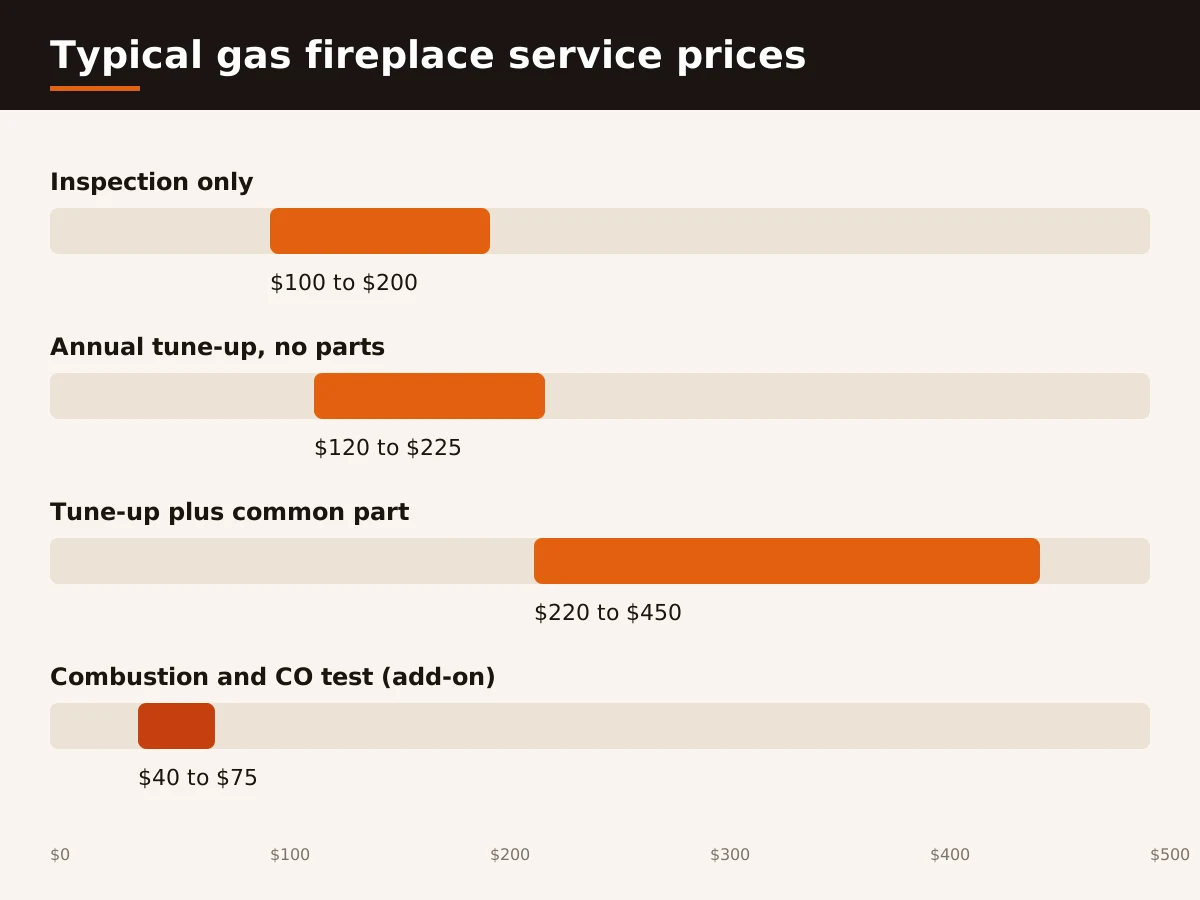
National price guides put a standard gas fireplace inspection at about $100 to $200, and DFW tends to land in the middle of that band. Larger jobs such as a burner rebuild or a gas line problem are priced after a technician has seen the unit, and any honest quote for them comes after a diagnosis, not before.
When to schedule one
Early fall is the best window, because the fireplace has sat unlit since spring and a technician can fix what summer did to it before the first cold snap, when everyone else is calling. A yearly inspection is the safe default. A lightly used fireplace can stretch to every other year, but propane units, vent-free units and anything in a home with recent construction dust belong on the annual schedule.
Schedule one sooner if you just bought the house and have no service history, if you have added a carbon monoxide alarm that has gone off, or if the flame has changed color. Place a working CO alarm on every level of the home and near sleeping areas regardless of what the inspection finds.
Gas smell: stop and call
If you smell gas, turn the fireplace off, keep flames and light switches away, open windows and leave the area. Call your gas utility or 911 from outside if the smell is strong, and do not try to relight or troubleshoot the unit yourself.
Once the area is safe and the source is dealt with, a technician can test the fittings and valve. We treat any reported gas smell as a same-priority safety visit.
What to ask before you book
- Does the price include a carbon monoxide reading, or is that extra?
- Is the quote for inspection only, or does it include cleaning?
- Does the visit include the outside vent termination?
- Will I get a written estimate before any part is replaced?
- Is the technician qualified on gas hearth appliances, not just chimneys?
If your gas logs sit inside a masonry fireplace, the chimney above them is a separate inspection. Our chimney services cover the flue side.
Due for a gas fireplace inspection?
We test the connections, the pilot, the venting and the CO reading, tell you plainly what we find and quote any repair in writing first. Based in Plano, serving DFW since 2013.
Common questions about gas fireplace inspections
What does a gas fireplace inspection include?
A leak test on the gas connections, a check of the pilot and thermocouple, the burner and pilot orifice, the glass and door gasket, the logs, the venting, the controls and a carbon monoxide reading.
How much does a gas fireplace inspection cost?
About $100 to $200 for an inspection alone. A full DFW tune-up with no parts runs roughly $120 to $225, and a combustion and carbon monoxide test adds about $40 to $75.
How often should a gas fireplace be inspected?
Once a year is the safe default. A lightly used fireplace can stretch to every other year, but propane, vent-free units and homes with recent construction dust should stay on an annual schedule.
What should I do if I smell gas near my fireplace?
Turn the fireplace off, keep flames and switches away, open windows and leave. Call your gas utility or 911 from outside if the smell is strong, and do not relight the unit yourself.
Is an inspection the same as a tune-up?
No. An inspection checks condition and safety. A tune-up also cleans the burner and resets the logs. Ask which one your quote covers when you book.