
Prefab or Masonry: How to Tell Which Chimney You Have
Four checks you can do from the living room, and why the answer changes what every repair costs.
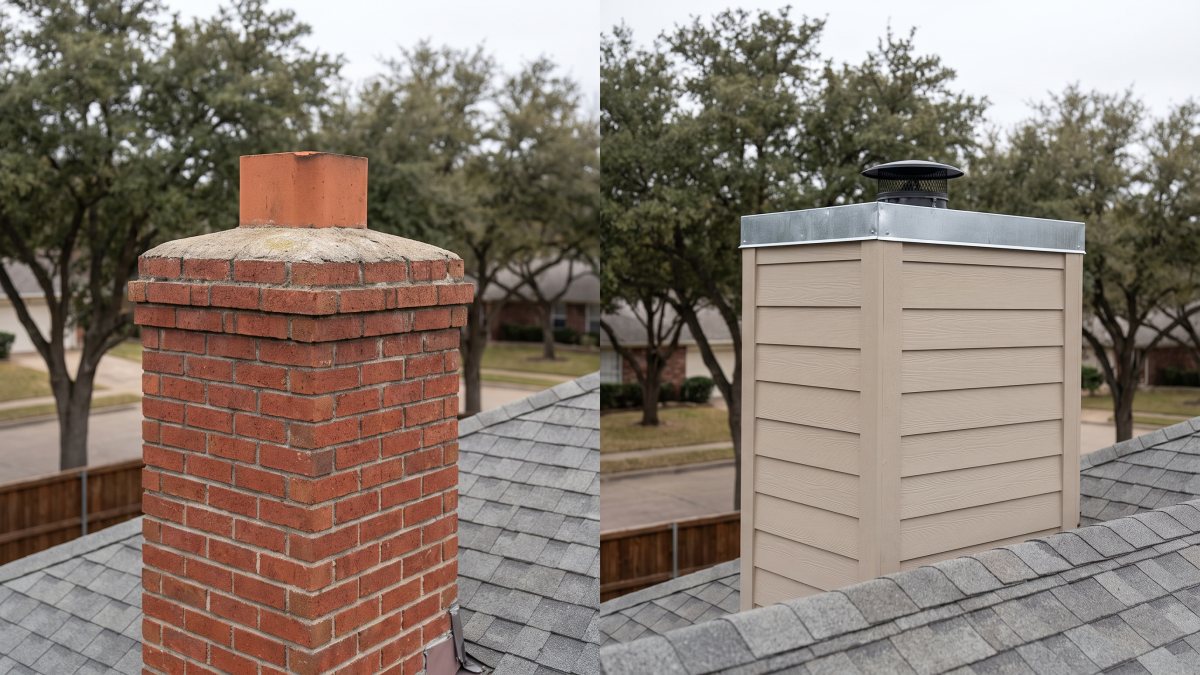
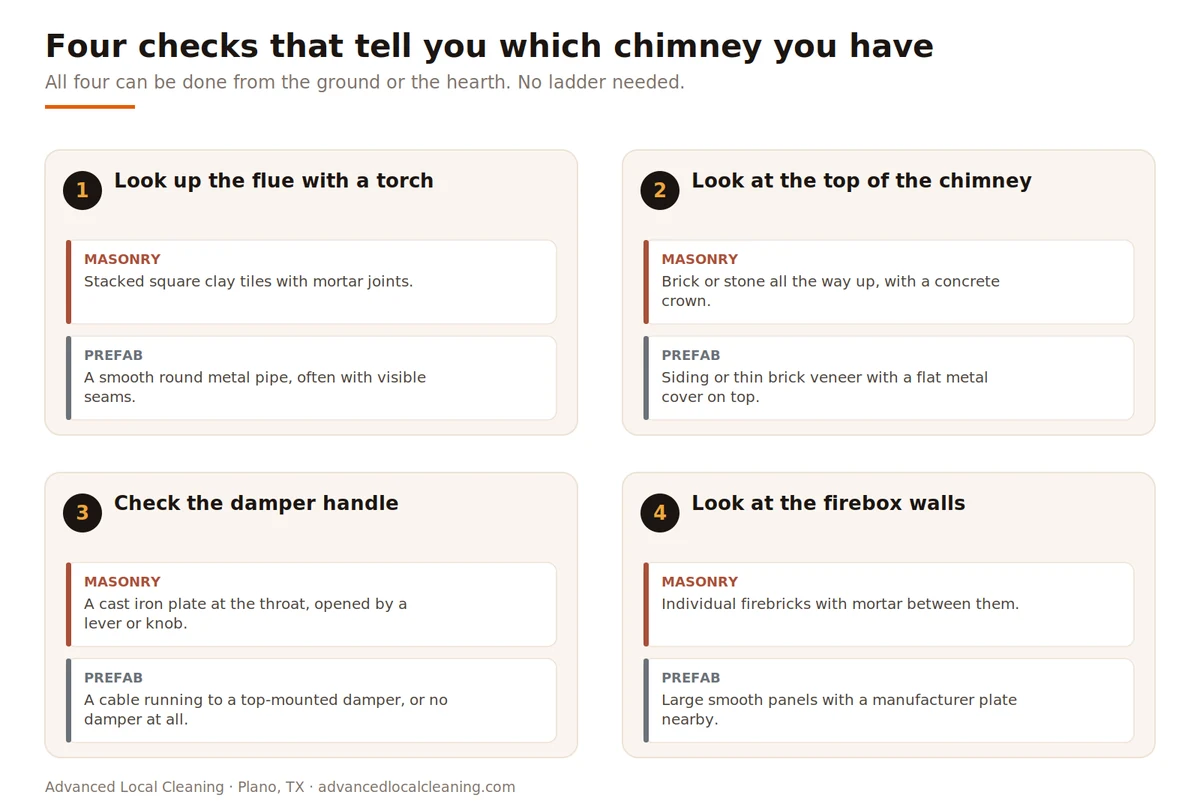
Look up your flue with a torch. Stacked square clay tiles with mortar joints between them mean you have a masonry chimney. A smooth round metal pipe means you have a prefabricated chimney, also called a factory-built chimney.
Three more checks confirm it. A masonry chimney is brick or stone all the way to the top and finishes in a poured concrete crown, it has a cast iron damper plate above the firebox, and its firebox is built from individual firebricks. A prefab is a wood-framed chase clad in siding or thin brick veneer, topped with a flat sheet of metal, with a firebox made of large smooth refractory panels and a manufacturer plate somewhere inside it.
In North Dallas the split is roughly generational. Homes built before 2000 are usually masonry. Homes built after 2000 are usually prefab.
Why this is the first thing to work out
Two houses on the same street can call about the same symptom and get quotes four hundred dollars apart. Nine times out of ten the reason is that one has a masonry chimney and the other has a prefab, and nobody explained the difference.
They are two different products that happen to do the same job. A masonry chimney is a structure. It carries its own weight down to a concrete footing in the ground, it was built on site by a bricklayer, and almost every part of it can be repaired in place. A prefab chimney is an appliance. It arrived on a truck as a steel firebox and a length of insulated pipe, a carpenter framed a box around it, and its parts get replaced rather than repaired.
That single difference decides what a repair costs, whether a repair is even possible, and how many years the thing has left. It takes about five minutes to settle, and it is worth doing before you accept anyone's quote.
Four checks that tell you which one you have
Do them in this order. All four can be done from your living room or your driveway, and none of them needs a ladder.
1. Shine a torch up the flue
Open the damper, get your head into the firebox, and point a light straight up. On a masonry chimney you will see stacked square or rectangular clay tiles, usually orange or buff, with a visible mortar joint every couple of feet. On a prefab you will see a smooth round metal pipe, dull silver, often with a faint ridge where two sections lock together.
This one check settles it about nine times out of ten. The other three are there for confirmation, or for when heavy soot has coated everything and the surfaces look the same.
2. Look at the top from the kerb
Walk to the end of the driveway and look at the last two feet of the chimney. A masonry chimney is brick or stone right to the top and finishes in a flat poured concrete slab called the crown, with the clay flue tile poking a few inches above it.
A prefab is finished in lap siding, stucco or a thin brick skin, and the top is a flat sheet of metal, usually galvanised grey and often streaked with rust, with a round pipe and a small cap coming through the middle of it. If the top of your chimney is metal, it is a prefab. Nothing else looks like that, and that metal sheet is the chase cover, which is the part most likely to be the reason you are reading this.
3. Find the damper control
Reach up inside the firebox and find whatever opens the damper. On a masonry chimney it is a cast iron plate sitting directly above the firebox opening, moved by a lever, a knob or a rotary handle. You can usually see the plate itself swing.
On a prefab you will often find a thin steel cable running down the inside of the firebox to a handle near the front. That cable runs up to a damper mounted at the very top of the flue rather than at the throat. Some prefabs do have a plate damper, so this check on its own is not conclusive, but a top-mounted cable damper is a reliable prefab tell.
4. Look at the firebox walls
A masonry firebox is built from individual firebricks, usually pale yellow or buff, with thin mortar joints you can trace with a finger. A prefab firebox is three or four large smooth panels, sometimes with a faint mould texture, and there will be a metal plate somewhere inside the firebox or tucked under the lintel carrying a manufacturer name and a model number.
Majestic, Heatilator, Superior, Marco, FMI and Temco are the names that turn up most often in North Texas homes. If you find that plate, stop looking. A manufacturer plate means factory-built.
What each type is actually built from
Once you know which one you have, the parts list explains most of the rest. A masonry chimney is a stack of solid materials with a clay liner running up the middle of it. A prefab is a hollow timber box wrapped around a metal pipe.
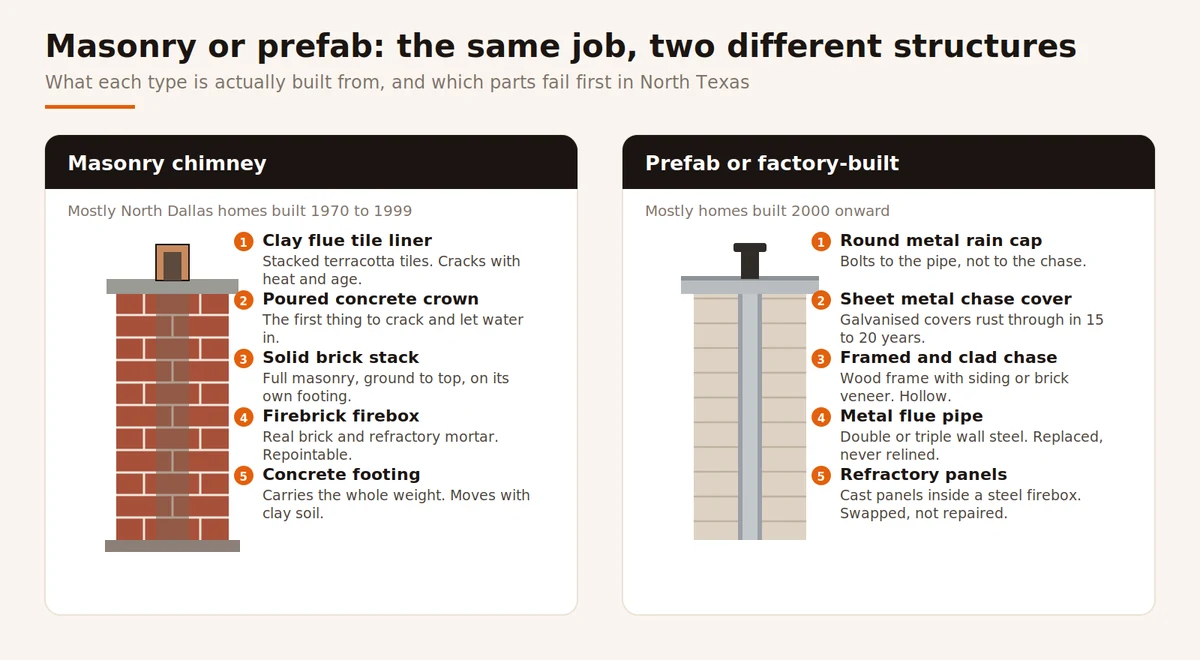
The hollow part matters more than people expect. Because a prefab chase is a framed box, water that gets past the chase cover runs down inside timber framing rather than down solid brick. A leak you cannot see from the room below can be soaking a stud wall for two seasons before anything shows on a ceiling.
What fails first, and roughly when
Each type has a predictable failure order, and knowing it tells you what to look at next.
On a masonry chimney, the crown cracks first, usually somewhere between fifteen and thirty years in. Water then gets into the top of the stack, mortar joints start eroding, and brick faces begin to spall. Flue tiles crack later, either from heat or from movement. Almost all of it is repairable in place, which is why repointing a masonry chimney is often cheaper than people expect.
On a prefab, the chase cover goes first, and it goes on a schedule. Builders through the 2000s fitted galvanised covers as standard, and galvanised steel under North Texas sun and hail gives you roughly fifteen to twenty years before it rusts through at the seams and the low corners. After that the cap works loose or lifts in a spring storm, the refractory panels crack from heat cycling, and eventually the pipe itself corrodes.
That fifteen to twenty year window is why chase covers are most of our summer work now. A house finished in 2006 is exactly at the age where its original cover starts letting water in.
Where the split falls across DFW
You can usually predict the answer from the year the house was built, and in the northern suburbs that maps closely onto the neighbourhood.
| Mostly masonry | Mostly prefab |
|---|---|
| Richardson, east and central Plano, older Carrollton, Garland and Dallas proper | Frisco, Allen, the newer McKinney additions, west Plano, Prosper and Little Elm |
| Built roughly 1965 to 1999 | Built roughly 2000 onward |
| Brick to the top, concrete crown, clay flue | Sided or veneered chase, metal cover, steel flue |
It is a guide rather than a rule. Plenty of 1990s homes went in with prefabs to save money, and some 2000s custom builds used real masonry. Streets built around the boundary years, roughly 1997 to 2003, are genuinely mixed, and that is where the four checks earn their keep.
What it means for the quote you were given
The same complaint gets a different fix depending on which chimney is producing it.
| The problem | On a masonry chimney | On a prefab |
|---|---|---|
| Water coming in at the top | Resurface or rebuild the crown, then waterproof the brick | Fabricate and fit a new stainless chase cover |
| Damaged flue | Reline with a stainless liner | Replace the affected pipe sections with matching factory parts |
| Cracked firebox | Cut out and replace firebrick, then repoint the joints | Replace the refractory panels with the manufacturer's parts |
| Crumbling exterior | Repoint the mortar and replace spalled brick | Repair the framing and cladding, which is carpentry rather than masonry |
| Beyond repair | Partial or full rebuild of the stack | The chase can be rebuilt, but the appliance itself gets replaced |
One quote to be careful with. If somebody has offered to reline your prefab chimney with a stainless liner, ask more questions. A factory-built system is listed and tested as a complete assembly, and fitting a non-matching liner inside it can void that listing, which matters if you ever need to make a claim. On a prefab you replace the pipe with the manufacturer's parts.
If the four checks still leave you unsure
Boundary-year houses, chimneys with heavy soot, and homes where a previous owner reclad a chase in brick can all resist a quick answer. A brick exterior with a metal pipe inside is a prefab that has been dressed up, and it is more common across DFW than most homeowners realise.
If you are stuck, take two photographs, one straight up the flue and one of the top of the chimney from the driveway, and call us. We can usually tell you over the phone in a minute, and there is nothing to pay for the answer. If you would rather have it confirmed properly, the free inspection covers it. We get on the roof, photograph what is up there, and show you the pictures before anything is quoted. You can see the full range of work we do either way.
Not sure what you have? Ask before you buy a repair.
Every job starts with a free inspection, so you find out which chimney you own and what it actually needs before anyone quotes a number. Based in Plano, working across the DFW metroplex since 2013.
Common questions about chimney types
Can a prefab chimney be converted to masonry?
Not in any practical sense. Converting means demolishing the chase, pouring a footing capable of carrying several tons, and building a masonry stack from the ground up, which usually costs more than the fireplace is worth. The realistic options are replacing the prefab unit with a new factory-built one, or fitting a wood stove or insert rated for the existing system.
How long does a prefab chimney last?
The appliance itself is generally good for twenty to thirty years with maintenance. The chase cover is the short-lived part. Galvanised covers fitted as builder standard through the 2000s typically rust through in fifteen to twenty years in North Texas, which is why so many Frisco and Allen homes need one now. A stainless replacement lasts considerably longer.
Does a prefab chimney still need sweeping?
Yes. Creosote forms in a metal flue the same way it does in a clay one, and a prefab flue is usually narrower, so a given amount of buildup restricts the draft sooner. The method differs, because metal pipe needs poly brushes rather than the wire ones used on clay tile, but the annual inspection and cleaning applies to both.
Is one type safer than the other?
Both are safe when they are intact and maintained, and both are dangerous when they are not. The difference is in how they fail. Masonry problems tend to show slowly through cracks and staining. Prefab problems are more often hidden inside the chase, which is why an annual look at the chase cover and the panels matters more on a factory-built system.
My chimney is brick outside but I found a metal pipe inside. Which is it?
It is a prefab. Chases are often clad in a thin brick veneer that looks identical to solid masonry from the street, and some owners rebrick a chase during a renovation. The flue decides it. A round metal pipe means factory-built, whatever the outside is wearing.