
Fireplace Refractory Panels: When Cracks Mean Replacement
Which cracks in your fireplace panels are normal, which ones mean replacement, and what the job typically costs in DFW.
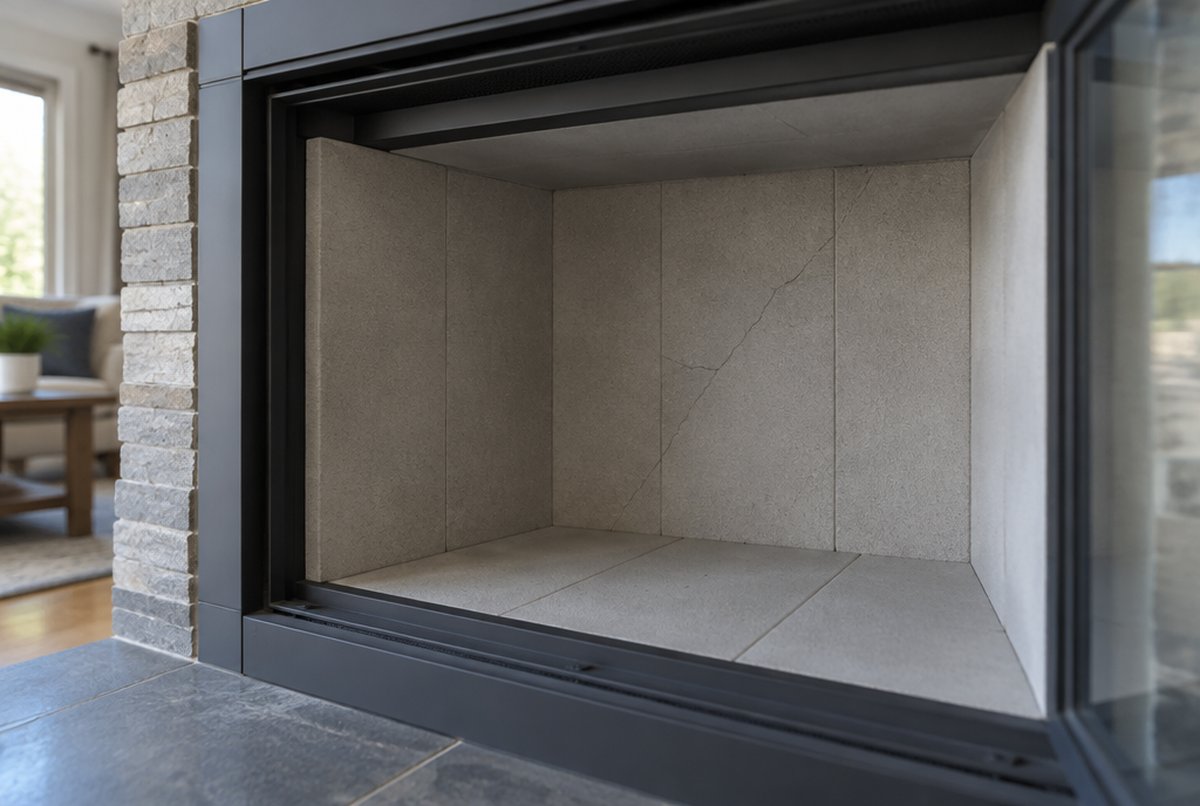
Refractory panels are the molded liners inside a factory-built fireplace, and they need replacing when a crack is wider than about one sixteenth of an inch and runs through the panel, when several cracks appear, or when the surface has worn away by roughly a quarter inch. Fine hairline cracks and thin gaps at the seams are normal. In DFW, replacing panels in a prefab firebox typically costs $300 to $900, depending on how many panels and which model. Check your manufacturer's manual first, because it sets the standard for your unit.
What refractory panels do in your fireplace
If your fireplace is factory-built, the inside of the firebox is not firebrick. It is a set of molded refractory panels, usually a back panel and two side panels, sometimes a floor panel too, set inside a metal shell. They are typically between half an inch and three quarters of an inch thick. Their job is to take the direct heat of the fire so the metal shell and the framing around it do not. Our guide to telling prefab from masonry shows how to check which kind you have, and the plain English map of your fireplace shows where the firebox sits in the whole system.
Most homes built in the DFW suburbs since the 1980s have this kind of unit, which is why panel questions come up so often here. The panels crack because they go through the same cycle every season: cold and dormant most of the year, then hot enough to glow during a long fire. A dropped log, a poker, or a fire built too big for the box finishes the job.
Which cracks are normal and which are not
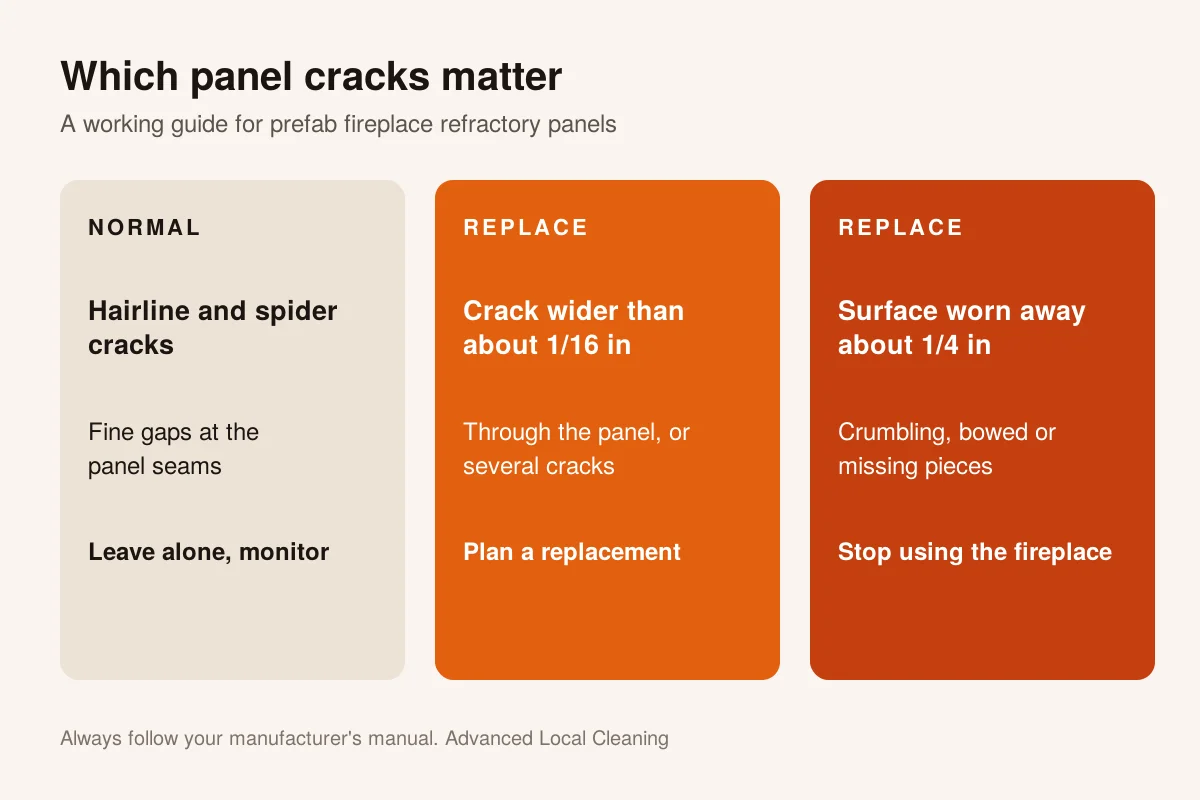
Fine hairline cracks and thin spider cracks on the surface are common and are usually just cosmetic. Hairline gaps where one panel meets the next are normal too, because the panels need room to expand when they heat up. This is also why filling those joints with cement is a mistake. A rigid fill locks the panels in place and the next heat cycle cracks them.
The cracks that matter are the ones that change how the panel behaves. Chimney industry guidance varies a little by source and by manufacturer, but the common thresholds are consistent enough to use as a working rule:
- A crack wider than about one sixteenth of an inch that runs through the panel, or several cracks in the same panel, is generally treated as a replacement item.
- A surface that has worn or eroded away by about a quarter inch or more means the panel has lost too much of its thickness to protect the metal behind it.
- A panel that is crumbling, bowed, missing a piece, or loose in its seat should be replaced whatever the crack width, and so should one where you can see the metal shell through it.
People often repeat a quarter inch rule for panels. That number is real, but it describes how much of the surface has eroded, not how wide a crack is. The width test is much tighter. Your fireplace manual, if you can find it, sets the standard that applies to your unit, and it wins over any rule of thumb.
Why panels crack in North Texas homes
Local conditions play a part. Many DFW fireplaces sit unused from spring until the first cold front, then get a big fire the first night because the family wants to enjoy it. Heating a cold panel hard and fast is the quickest way to stress it. Starting with a small fire and building it up over twenty minutes or so is easier on the panels, and so is burning seasoned hardwood instead of stacking the box with green wood that burns unevenly. Our first fire checklist walks through the steps for the start of the season.
Gas fireplaces with a log set are not exempt. Panels behind gas logs get less abuse from logs and pokers, but they still crack from heat cycles, from a burner flame that is set too high, and from moisture if water ever gets down the flue. If the panels behind your logs look cracked or sooty in a new pattern, the burner and flame pattern deserve a look as well.
Can a cracked panel be repaired instead?
Sometimes a small crack in a panel that is otherwise sound can be monitored rather than replaced, and a technician may suggest that. The honest answer for anything beyond that is no. Patching a through crack with refractory cement rarely lasts, because the panel keeps flexing with every fire, and a patch can hide a failing panel without protecting the shell behind it. If a company offers to skim over wide cracks with cement and call it done, ask to see the crack up close and ask why it will hold.
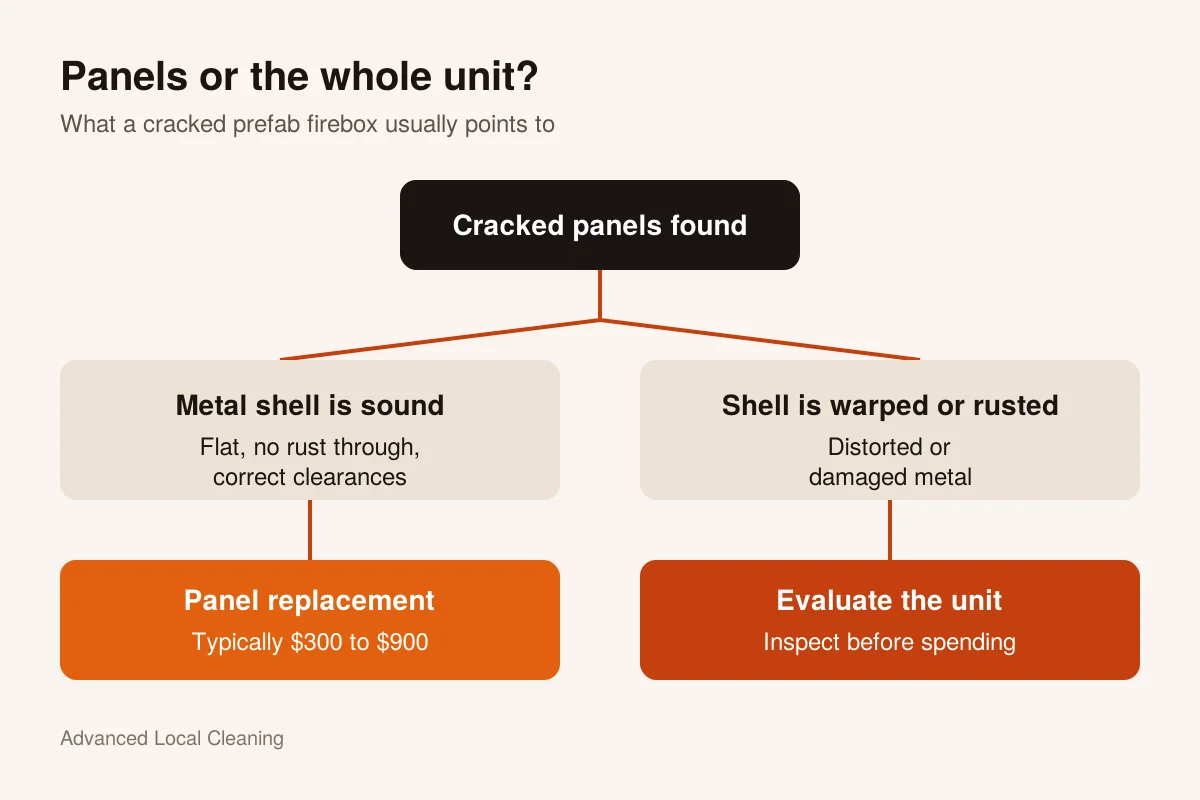
Check the metal too. If the shell behind the panel is warped, rusted through or distorted, the question changes from replacing panels to whether the whole unit is safe to keep using, because warping can reduce the clearances between a prefab firebox and the framing around it. A technician should look at this before quoting panels alone.
What replacement involves
Replacement panels have to match the unit. The make and model are usually printed on a metal tag inside the firebox, often on the side wall or behind the grate or log set. With that number, the right panels can be ordered for your fireplace. Prefab fireplaces are tested and listed as a complete system, so the panels should be the manufacturer's part or an approved equivalent for that model, cut and seated with the right fit and gaps. Clearances around a prefab firebox can be as small as half an inch to an inch, so sizing matters.
The work itself is straightforward for a trained tech. The old panels come out without damaging the shell, the firebox is cleaned, and the new panels go in tight to the shell with the expansion gaps left alone. If the tag is missing or unreadable, the panels can be measured by height, width and thickness instead.
What panel replacement costs in DFW
Replacing refractory panels in a prefab fireplace typically runs between $300 and $900. The spread comes from a few things you can predict:
- How many panels need replacing. A single side panel is the low end, and a full set is the high end.
- Whether the manufacturer part is common or has to be special-ordered. Parts for older or discontinued models can take longer and cost more.
- How easy the firebox is to reach. Gas log sets, glass doors and tight surrounds add labor.
Treat those numbers as a starting point, not a quote. A written estimate after an inspection is the only way to get a number for your unit. It should list the panels, the part source and the labor separately.
When panels are not the answer
Masonry fireplaces do not use these panels. They use firebrick set in refractory mortar, and the cracking rules and repair options are different. If your cracks are in brick or mortar joints, that is a firebox repair, not a panel replacement, and a technician can tell you whether repointing or a partial rebuild fits. For a prefab, if the shell is warped or the unit is badly worn, a full replacement of the fireplace may be the safer choice, and that is worth knowing before you put money into panels.
Questions to ask before you approve the work
A good estimate is specific. Ask which panels are being replaced and why, whether the part is the manufacturer's or an aftermarket equivalent, and what the company does if the model tag cannot be found. Ask to see the cracks and the shell in photos before and after. Ask whether the flue and damper were checked while the firebox was open, since cracked panels are sometimes a sign of overfiring or draft trouble rather than just age.
What you can do before a technician comes
Take clear photos of each cracked panel with a ruler or coin beside the crack, and find the model tag. Stop using the fireplace if a panel is crumbling or you can see metal. Do not seal gaps with cement or caulk. Our inspection checklist covers what a technician looks at beyond the panels, and the sweep and inspection that go with chimney repair are a good time to have the firebox looked at too.
If you want a professional opinion on what you have, our fireplace repair page explains how we diagnose wood and gas fireplaces and how the estimate works.
Not sure if your cracks mean replacement?
We look at the panels, the metal shell and the flue, show you what we find, and give you a written, itemized estimate before any work begins. Based in Plano, working across DFW since 2013.
Common questions about refractory panels
When should refractory panels be replaced?
Replace them when a crack runs through the panel and is wider than about one sixteenth of an inch, when several cracks appear, or when the surface has eroded by about a quarter inch. Your manufacturer manual sets the standard for your unit.
How much does refractory panel replacement cost in DFW?
It typically runs between $300 and $900, depending on how many panels need replacing, the fireplace model and how easy the firebox is to reach.
Are hairline cracks in refractory panels normal?
Yes. Fine hairline and spider cracks and thin gaps at the seams are common and usually cosmetic. They are worth monitoring because they can grow.
Can I repair a cracked refractory panel with cement?
Cement rarely lasts on a panel with a through crack, and sealing the seams can cause new cracks because the panels need room to expand. Replacement is the reliable fix.
Do masonry fireplaces have refractory panels?
No. Masonry fireplaces use firebrick set in refractory mortar. Refractory panels are used in factory-built fireplaces.