
Firebox, Flue and Damper: A Plain English Map of Your Fireplace
Every part of a fireplace from the hearth to the cap, what it does, and the way it usually fails.
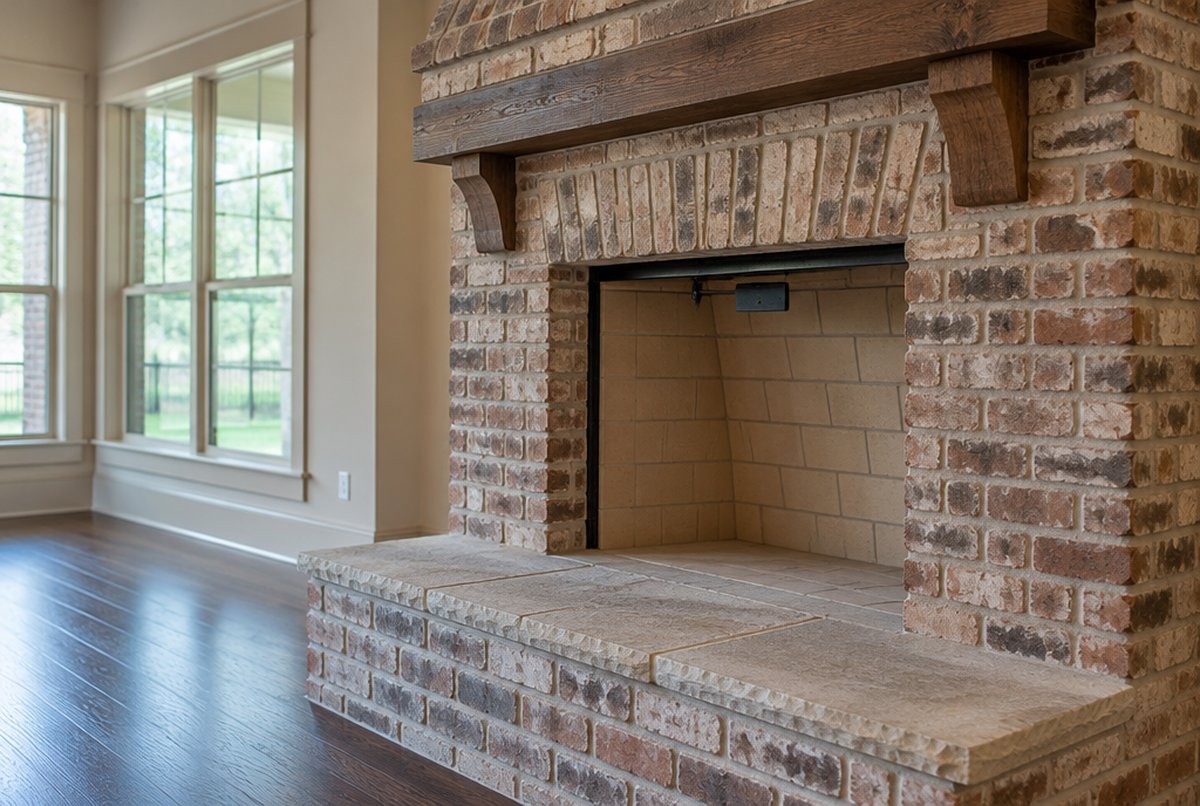
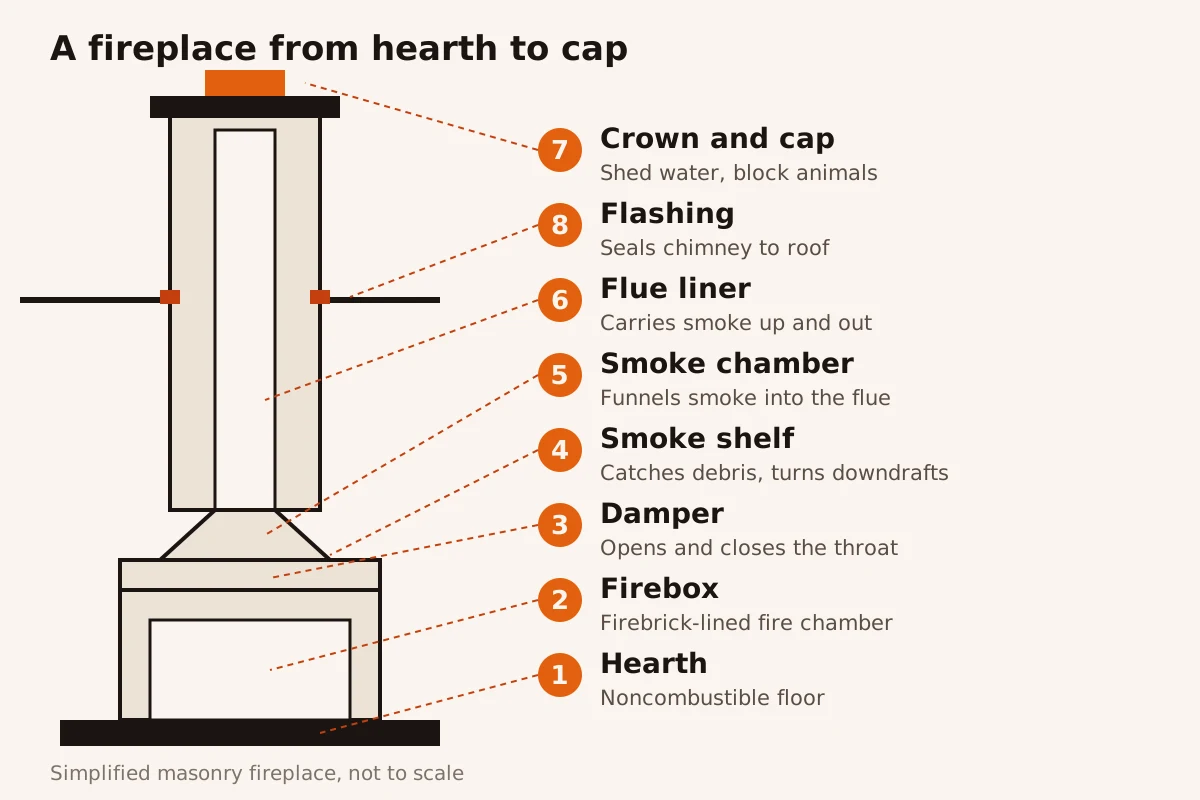
A fireplace has eight main parts, and they run in a line from the floor to the sky. The hearth and firebox hold the fire, the damper at the throat opens and closes the passage, the smoke shelf and smoke chamber funnel smoke inward, the flue liner carries it up the chimney, and the crown, cap and flashing keep rain, animals and sparks out at the top. Each part fails in its own way, from cracked firebrick to a rusted damper to a leaking roof joint, and knowing the order lets you describe a problem accurately to a technician before anyone climbs a ladder.
Why the order matters
Smoke takes one path out of your house, and every part of the fireplace sits somewhere on it. When something goes wrong, the symptom usually shows up in one place and the cause sits in another. Smoke in the living room might come from a damper that never opened, a flue that is cold, or a cap clogged with leaves. If you know the route, you can narrow it down fast. This guide follows that route from the hearth to the cap and says what each part does and how it tends to fail. It describes a masonry fireplace first and covers factory-built units further down.
Start at the floor: hearth and firebox
The hearth is the noncombustible floor in front of and under the fire. It runs out into the room so a stray ember lands on brick or stone instead of carpet. The firebox is the open chamber where the wood burns, lined on the back and sides with firebrick set in thin refractory mortar. That lining is built to take heat, and it still cracks over time.
Hairline cracks in the mortar joints are common and usually cosmetic. Missing mortar, bricks that have shifted, or a gap wide enough to slip a coin into is a different matter, because the masonry behind the lining is then taking heat it was never meant to take. North Texas clay soil swells and shrinks with the weather, and a house that settles can open a gap where the hearth meets the floor or crack the firebox. A new gap that was not there last year is worth noting.
Two details are easy to miss. Across the top of the firebox opening sits a steel or stone lintel, the beam that carries the brick above it, and rust or a visible sag there is worth a technician's look. Some masonry fireplaces also have an ash dump, a small door in the firebox floor that drops ashes into a pit below, with a cleanout door at the bottom. Keep the dump door closed while you burn and make sure the cleanout door shuts tight, since a loose one lets air in from below.
The throat and the damper
Just above the firebox opening, the passage narrows into the throat, and the damper sits there. A damper is a metal plate or door that opens to let smoke up and closes to keep heated or cooled air from escaping up the chimney when the fireplace is idle. Some homes have a top-sealing damper at the cap instead, worked by a chain, and these tend to seal better than a throat damper.
Most damper trouble is mechanical: a handle that will not move, a plate rusted partway open, or a seal that has warped so it never closes tight. A damper stuck open leaks conditioned air all winter, and one stuck closed fills the room with smoke the moment you light a fire. Before you strike a match, open it fully and look up to confirm. Our guide to chimney draft explains why a cold flue can push smoke back into the room even with the damper open.
Smoke shelf and smoke chamber
Behind and above the damper is the smoke shelf, a flat ledge at the back of the throat. It catches rain and debris that fall down the flue and turns downdrafts so they do not blow straight into the room. Above it is the smoke chamber, a sloping, funnel-shaped space that narrows from the width of the firebox to the width of the flue.
In a well-built chimney the chamber walls are smooth, because rough stair-stepped brick catches soot and makes cleaning harder. Older chimneys sometimes have walls that were never smoothed. This area is hard to see without a light and a mirror, so it tends to get ignored until soot or smoke problems appear.
The flue and its liner
The flue is the passage that carries smoke out of the house, and in most chimneys it is lined. The liner is usually clay tile in a masonry chimney, or stainless steel in a relined or factory-built one. It protects the brick and the framing around the chimney from heat and from the acidic byproducts of burning wood. Cracked or offset tiles let heat and gases reach places they should not, which is why a damaged liner is a safety issue and not a cosmetic one.
Flue size matters as well. Too large and it drafts poorly and collects creosote, too small and smoke spills into the room. We cover that in what a chimney flue is and whether yours is the right size. The flue is also where creosote builds up, and our guide to the three creosote stages shows what each looks like. If a liner is cracked beyond saving, chimney liner installation is the usual answer.
Above the roof: crown, cap and flashing
What you see from the yard is the chimney stack, and three parts at the top do the weather work. The crown is the concrete or mortar slab across the top of the masonry that sheds water off the edges. Cracks in it let water into the brick below, and over a few winters of North Texas freeze and thaw that adds up. The cap is a metal or stone cover over the flue opening, usually with mesh sides that keep out rain, birds and animals and stop sparks from landing on the roof. Flashing is the metal strip that seals the joint where the chimney meets the roof. It is the usual source of a leak that shows up on the ceiling beside the chimney, and our chimney flashing repair page covers the fix.
The three are easy to mix up, especially on newer homes. Our guide to the chimney cap, crown and chase cover sorts out which is which.
If your fireplace is factory-built
Not every fireplace is brick. Many newer homes have a prefabricated metal firebox with an insulated metal flue pipe, wrapped in a framed enclosure called a chase and topped with a chase cover instead of a crown. The names shift: refractory panels instead of firebrick, a damper that is usually built into the unit, and a pipe instead of a tile liner. The failure points shift too, with rusted chase covers and cracked refractory panels more common than crumbling mortar. If you are not sure which type you have, our guide to telling prefab from masonry will settle it.
Matching a symptom to a part
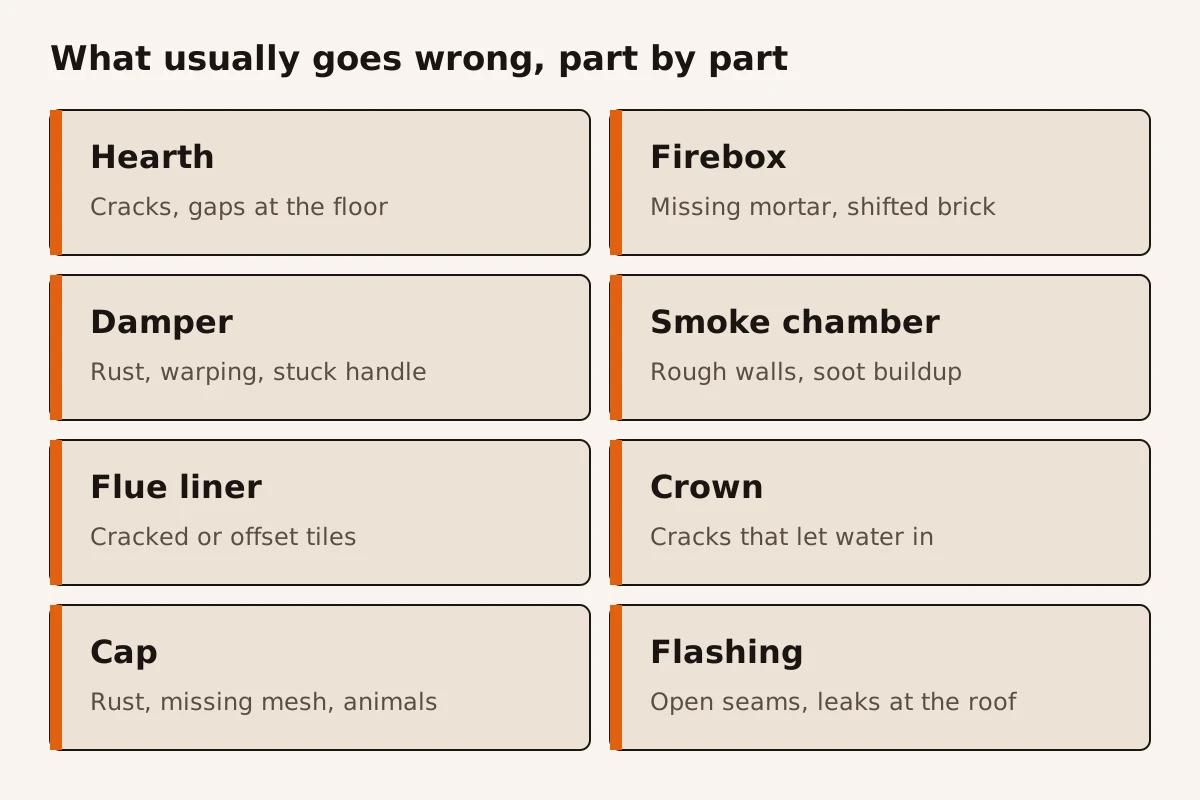
You can work backward from what you notice. These are the common pairings, not a diagnosis, but they point you to where to look first.
- Smoke in the room while burning: check the damper position first, then a cold flue, a blocked cap, or a flue that is the wrong size.
- A musty or sooty smell: creosote residue in the flue, or water getting in from above.
- Water stains on the wall or ceiling beside the chimney: flashing, crown or cap.
- White powder or flaking brick on the outside: moisture moving through the masonry.
- Bits of tile or grit in the firebox: a deteriorating liner or a crumbling crown.
- A damper that sticks or will not close: rust, warping or soot.
What you can check yourself
With the fireplace cold and a flashlight, you can open the damper, look over the firebox floor and walls, and see a little of the smoke shelf by reaching past the damper blade. From the yard, a pair of binoculars shows the cap and crown well enough to spot rust or cracks. Please stay off the roof. Everything inside the flue and smoke chamber needs a camera or a trained eye, and a fall from a roof is a far worse outcome than any chimney problem.
A sweep and inspection looks at all of these parts in one visit, and that is the easiest way to learn the real condition of yours. If something does need work, fireplace repair covers the firebox, damper and hearth, and the full list of what we do is on our chimney services page.
Not sure which part is acting up?
Tell us what you are seeing and we will help you narrow it down, then check the whole route from hearth to cap with photos so you can see for yourself. Based in Plano, working across DFW since 2013.
Common questions about fireplace parts
What are the main parts of a fireplace?
The hearth, firebox, damper, smoke shelf, smoke chamber, flue liner, crown and cap, and flashing. Smoke passes through them in that order on its way out of the house.
What is the difference between a damper and a flue?
The damper is a movable plate at the throat that opens and closes the passage. The flue is the passage itself, the channel that carries smoke up through the chimney.
What is the smoke chamber?
It is the sloped, funnel-shaped space above the damper that narrows from the width of the firebox to the width of the flue. Smooth walls help smoke move and make cleaning easier.
What is the firebox made of?
In a masonry fireplace the firebox is lined with firebrick set in refractory mortar. Factory-built fireplaces use a metal firebox with refractory panels instead.
Which fireplace part fails most often?
Dampers and the parts above the roof see the most trouble. Dampers rust or stick, and crowns, caps and flashing take the weather and let water in once they crack or open up.