
Storm Damaged Chimney: What Insurance Covers in North Texas
What homeowners insurance usually pays for after hail or wind hits a chimney, how the deductible changes the math, and how to document a claim.
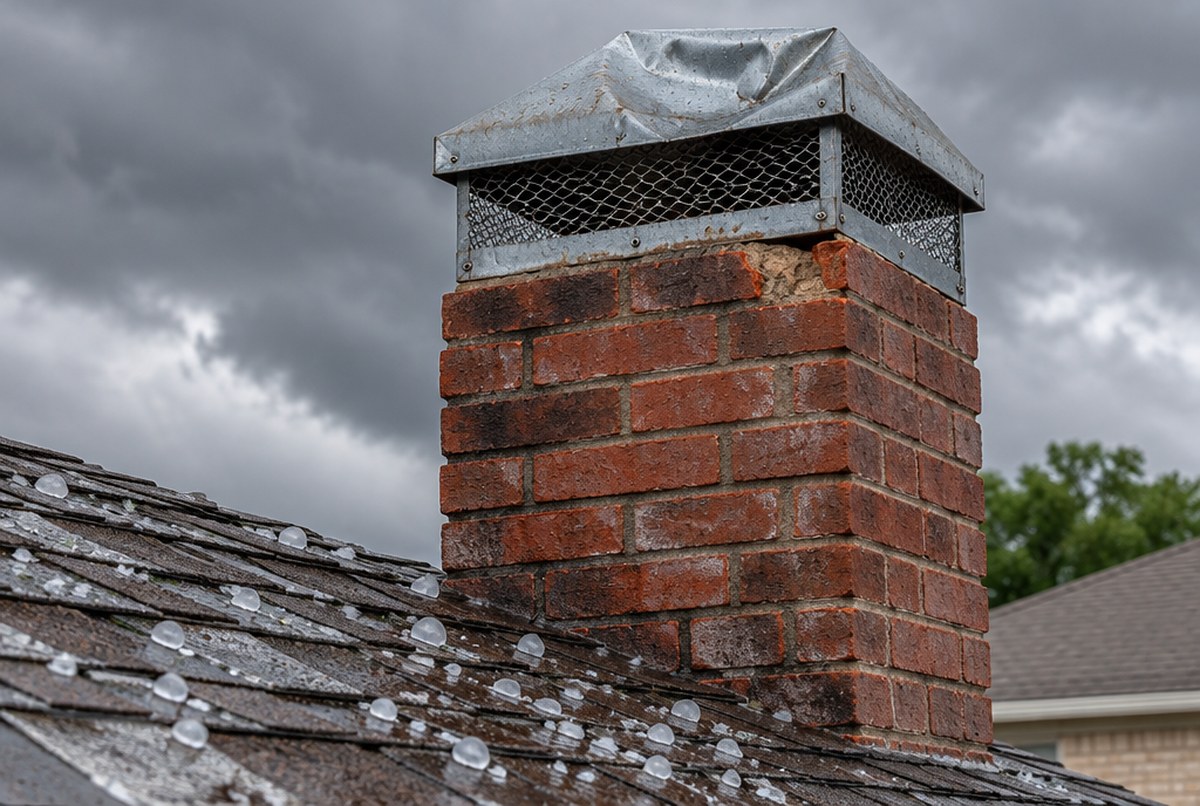
Homeowners insurance in Texas usually pays for chimney damage that a storm causes suddenly, such as hail denting a cap, wind tearing it off, or a limb landing on the stack. It usually does not pay for wear, rust, crumbling mortar or leaks that built up over time. The catch is the wind and hail deductible, which is often 1 to 5 percent of your dwelling coverage and can be larger than the repair itself. Photograph the damage before anyone touches it, report it promptly, and get a written repair estimate so you can compare it to your deductible before you decide whether to file.
What counts as storm damage to a chimney
A chimney sits higher than almost everything else on the house, so it takes the first hit from hail and the strongest wind. In North Texas the damage usually falls into a few groups. Hail dents or punctures the metal cap, chase cover and spark arrestor mesh, and it can chip or crack a concrete crown. Wind bends or tears off a cap, or lifts the edge of a chase cover. A limb or a whole tree comes down and breaks the top courses of brick or shears the stack off at the roofline. Lightning is rarer, but it can leave cracked masonry and now and then a split liner.
What these have in common is that they happened on a date you can name. Insurance is built to pay for sudden events, and that one idea explains most of the coverage decisions below.
What homeowners insurance usually covers
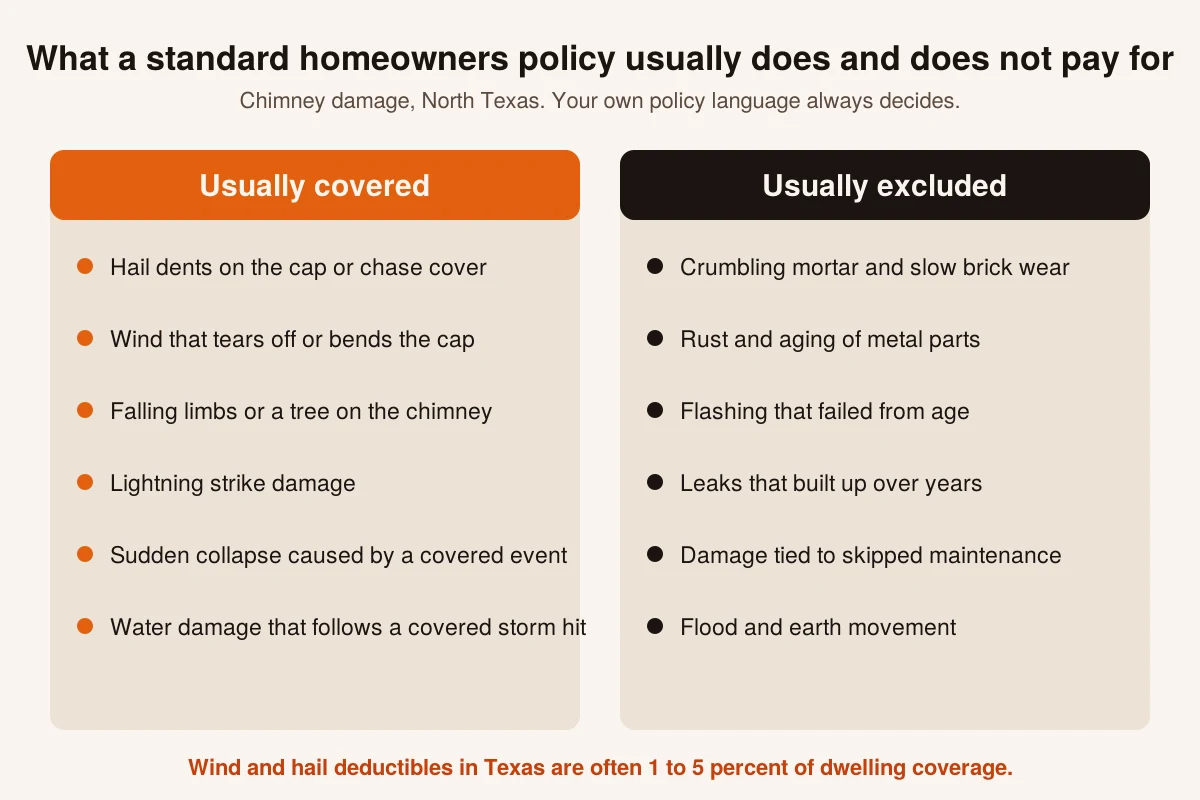
Most standard homeowners policies treat the chimney as part of the dwelling, so it is covered against the same perils as the rest of the house. For a chimney, the ones that matter are wind, hail, lightning and falling objects. If one of those damages the cap, the crown, the flashing or the brick, the repair is generally a covered loss, minus your deductible. Water that gets into the house through a storm-damaged chimney is usually treated as part of the same loss, while water from a slow leak is not.
Texas policies do vary. Some carry a separate wind and hail section, some add exclusions for cosmetic damage, and some limit payment on older components. A general article cannot tell you what your policy says. Your declarations page and the wind and hail section of the policy are the documents that decide.
What it usually excludes
Policies exclude wear and tear, deterioration, rust and neglect. Crumbling mortar, spalled brick, a rusted cap and flashing that has pulled away after years of weather generally land here, and so do leaks that built up slowly. Our guides to spalling brick and rebuild versus repair show what age-related damage looks like, which is worth knowing because an adjuster will look for it.
Disputes tend to start when a storm hits a chimney that was already old. The insurer points to the age and the homeowner points to the storm. Photos that show fresh damage help, such as bright metal at a dent, clean-edged chips in a crown, or storm debris around the base. Records of past sweeps and inspections help show the chimney was looked after. Neither guarantees an outcome, but both are the evidence that carries weight.
The deductible often decides whether to file
This is where many DFW homeowners get surprised. Texas wind and hail deductibles are usually a percentage of your dwelling coverage rather than a flat dollar amount. Industry guides put the range at 1 to 5 percent, with 2 percent the common standard across the state and some North Texas carriers asking for 3 percent. On a home insured for $400,000, a 2 percent deductible means you pay the first $8,000 of storm damage.
Compare that with chimney repair prices. In our guides, a galvanized chase cover in DFW runs roughly $450 to $700 installed and a stainless one $750 to $1,300. Crown repair is commonly cited at $750 to $1,000, and rebuilding the stack above the roofline at $1,000 to $4,000. A cap or crown job alone often comes in under a typical percentage deductible, which would mean a claim pays nothing. The picture changes when the roof was damaged too, because the chimney can ride along on a claim that already clears the deductible, or when the stack itself is broken.
The sensible order is to get the written estimate first, find your actual deductible on the declarations page, and then decide whether to file. It is also fair to ask your agent whether a claim that pays nothing still goes on your record, since that answer differs by insurer.
Signs of hail and wind damage on a chimney
You can check a lot from the ground with binoculars or the zoom on a phone. Stay off the roof after a storm. Look for:
- Dents or creases in the cap, the chase cover or the mesh, especially with bare or bright metal at the dent.
- A cap that sits crooked, has lifted at one edge or is missing.
- Chips or cracks across the crown, the concrete slab at the top of a masonry chimney.
- Flashing at the roofline that has lifted, bent or pulled away from the brick.
- Fresh chips, missing bricks or open mortar joints near the top courses.
- New water stains on the ceiling or wall near the chimney, or a damp smell at the fireplace after rain.
Chimney damage from hail often shows up alongside roof damage, so it makes sense to check both on the same day. If water is already coming in, our chimney leak repair page explains how leaks around a chimney are traced and fixed.
Document everything before anyone touches it
Good records do more for a claim than anything else you control. Before any temporary fix or repair:
- Take dated photos and short video clips of each damaged area, close up and wide, with a coin or ruler for scale. Photograph the roof, the yard and the street if hail or debris is visible.
- Write down the date and time of the storm, and note whether neighbors had damage too. Weather service reports and local news coverage of the storm back up the date.
- Gather past records: invoices from earlier sweeps, inspections or repairs, and any photos of the chimney from before the storm, even ones taken at a family gathering or for a home listing.
- Get a written, itemized repair estimate from a chimney company that looked at the damage in person.
- Keep every receipt for temporary protection, and keep damaged parts such as a bent cap until the claim is closed.
- Log every call and email with your insurer: the date, the person, and what was said.
Protect the house, then wait for the adjuster
Most policies expect you to take reasonable steps to prevent more damage, and insurers commonly reimburse those costs as part of the claim when you keep the receipts. A tarp over an open flue or a temporary cap is reasonable. A full rebuild before the adjuster has seen the damage is not, because it removes the evidence. If the chimney is leaning, shedding brick or open to the weather, stay away from using the fireplace until it has been inspected. Our chimney repair page lists the repairs we do and how an estimate works.
Check with your insurer before you pay for anything permanent. Many will tell you on the phone what they plan to reimburse.
How the claim moves and how long it takes
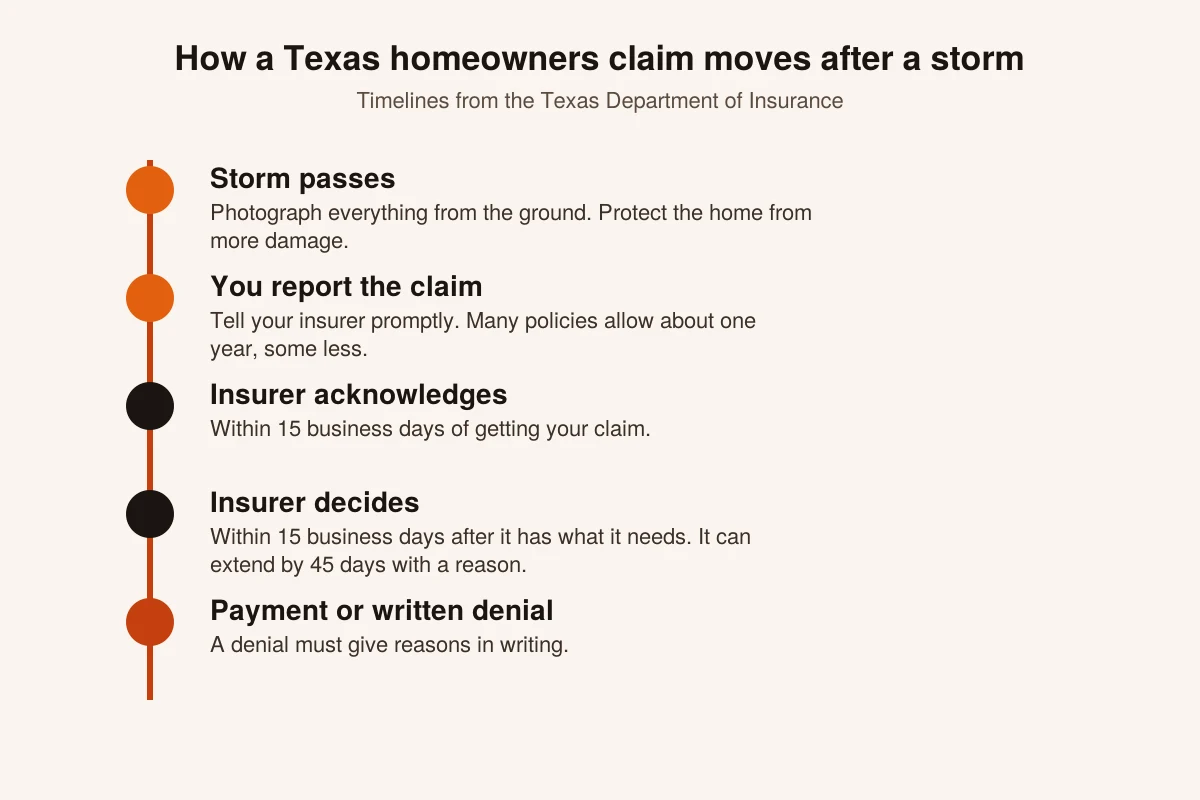
The Texas Department of Insurance sets the clock. Your insurer has 15 business days to confirm it received your claim. Once it has what it needs from you, it has 15 business days to decide whether it will pay, and it can extend that by 45 days if it explains why. A denial has to come with the reasons in writing. Many policies also set a window for reporting storm damage in the first place, commonly about a year from the storm and sometimes shorter, so reporting promptly is the safe move. The TDI page on claim deadlines has the details.
When the adjuster visits, be there. Walk them to the chimney specifically, because it is easy for it to be missed when a visit centers on the roof. Show them your photos, the estimate and the maintenance records, and ask that the chimney be noted in their report.
What a chimney company can and cannot do for your claim
Texas law is strict here, and it protects you. A contractor may not offer to waive, rebate or absorb your deductible, and a contractor who also does the repair may not act as your public adjuster, file the claim for you or negotiate the settlement for you. After big DFW hailstorms, door-to-door crews sometimes promise exactly those things. The TDI guidance on roofing and insurance law lays out the rules for contractors who repair storm-damaged property.
What we can do is inspect the chimney, photograph what we find, and give you a written, itemized estimate you can hand to your insurer. You handle the claim. That keeps everything above board and keeps the estimate honest.
If the claim is denied or the offer is too low
Ask for the reasons in writing and read which exclusion or limit the insurer relied on. If you think the chimney damage was missed, ask for a reinspection and send your photos and estimate. If the dispute continues, you can file a complaint with the Texas Department of Insurance, and some homeowners bring in a licensed public adjuster or an attorney. We are chimney technicians, not adjusters or lawyers, and this article is general information rather than advice about your policy.
Did a storm hit your chimney?
We inspect the cap, crown, flashing and masonry, photograph what we find, and give you a written, itemized estimate for your records. Based in Plano, working across DFW since 2013.
Common questions about chimney storm damage and insurance
Does homeowners insurance cover chimney storm damage in Texas?
Usually yes for sudden damage from wind, hail, lightning or falling objects, minus your deductible. Wear, rust, neglect and slow leaks are typically excluded. Your policy wording decides.
Is chimney hail damage worth filing a claim for?
It depends on your wind and hail deductible, which is often 1 to 5 percent of dwelling coverage. Get a written repair estimate and compare it to your deductible before you file.
How long does the insurance company have to respond in Texas?
The Texas Department of Insurance says an insurer has 15 business days to acknowledge a claim and 15 business days after getting what it needs to decide, with a possible 45 day extension if it explains why.
Can a chimney company file my claim or waive my deductible?
No. Texas law bars contractors from waiving or absorbing your deductible and from acting as your adjuster or negotiating the claim for you. A contractor can inspect, document and provide a written estimate.
Should I repair the chimney before the adjuster visits?
Protect the house from more damage with temporary measures and keep receipts, but hold permanent repairs until the insurer has seen the damage and approved the plan.