
What Does It Cost to Replace a Chimney Chase Cover in DFW?
Real installed ranges for North Texas, the five things that move the price, and what another year of waiting adds to it.
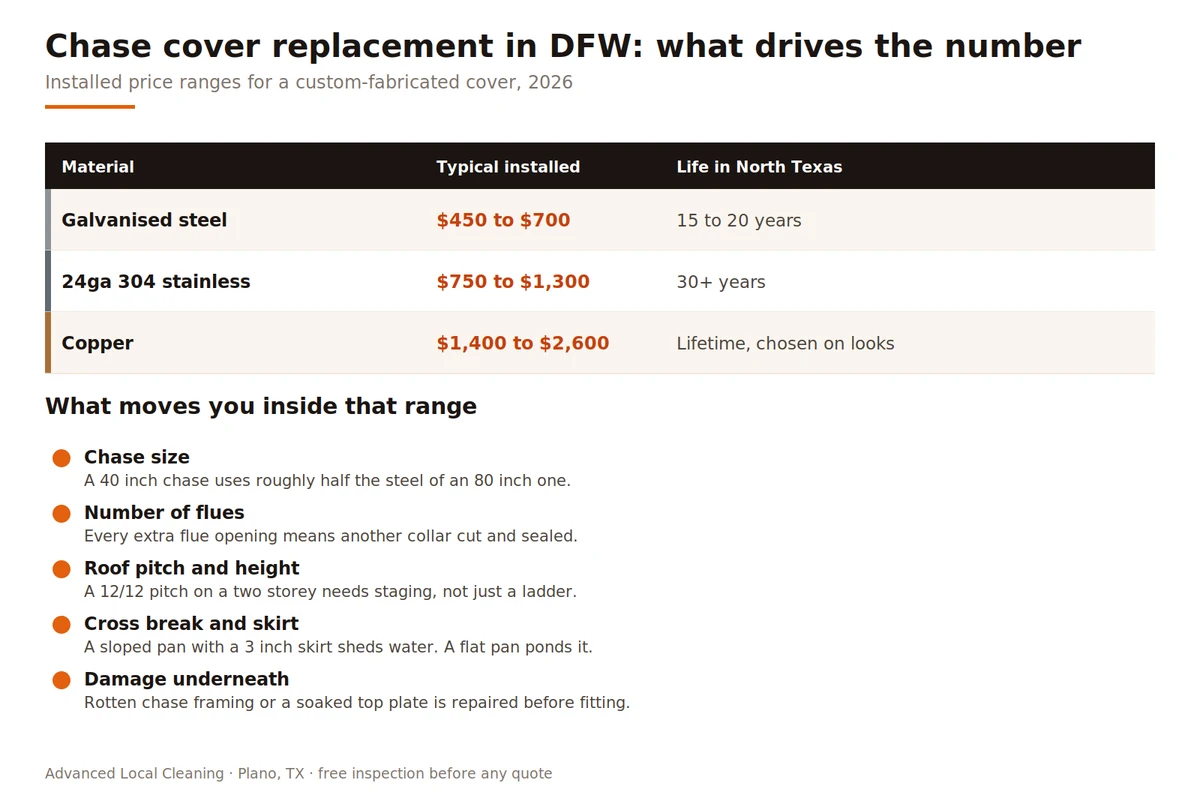
Replacing a chimney chase cover across Dallas-Fort Worth runs roughly $450 to $700 for galvanised steel and $750 to $1,300 for 24 gauge stainless, installed, on a typical single-flue prefab chase. Copper sits between $1,400 and $2,600 and is chosen for how it looks rather than how it performs.
Where you land inside those ranges depends on the size of the chase, how many flue openings the pan has to be cut for, roof pitch and access, and whether the cover is fabricated with a cross break and a deep skirt or pressed flat and dropped on.
All of that assumes the framing underneath is dry. If water has already reached the chase top plate, carpentry gets added before anything new goes on.
First, make sure a chase cover is what you need
Three parts at the top of a chimney get confused with each other, and quotes get compared that were never for the same job.
The chase cover is the large flat metal pan that covers the entire top of a prefab chimney chase, the way a shoebox lid covers a shoebox. The cap is the small round or square hood that sits on the flue pipe coming through that pan and keeps rain and animals out of the flue itself. The crown is the poured concrete slab on top of a masonry chimney, and prefabs do not have one.
If you are not certain which kind of chimney you have, the flue settles it in about ten seconds. Our guide to telling a prefab from a masonry chimney walks through the four checks. Chase covers only exist on prefabs. On a masonry stack the equivalent conversation is crown repair, and it prices completely differently.
What it costs in DFW
These are installed prices, meaning fabrication, delivery, removal of the old pan and fitting the new one. They are what we see across the metroplex in 2026 rather than a national average.
| Material | Typical installed price | Life in North Texas |
|---|---|---|
| Galvanised steel | $450 to $700 | 15 to 20 years |
| 24 gauge 304 stainless | $750 to $1,300 | 30 years and up |
| Copper | $1,400 to $2,600 | Effectively lifetime, chosen on appearance |
A very large chase, three or four flue openings, or a steep two-storey roof can push a stainless cover past $1,300. Those are the outliers rather than the norm, and a decent estimator will tell you on the phone if yours looks like one.
What moves you inside the range
Five things account for almost all of the variation, and none of them are guesswork once somebody has measured the chase.
- Chase size. Covers are made to order, so a 40 inch chase uses roughly half the sheet of an 80 inch one. This is the single biggest driver.
- Number of flues. Every opening in the pan is another collar cut, formed and sealed. A two-flue chase is meaningfully more work than a single.
- Pitch and access. A 6/12 pitch on a single storey is a ladder job. A 12/12 on a two storey needs staging and a second technician, and that shows up in the labour line.
- Cross break and skirt depth. A cover formed with a cross break, which is a shallow ridge that slopes water off all four sides, and a skirt of at least three inches down the sides of the chase, costs more to fabricate and is the difference between a cover that drains and one that ponds.
- What is underneath. If the old pan has been leaking for a while, the chase top plate and the framing under it may be soft. That gets repaired first, and it is the line most likely to change between the quote and the invoice, which is why it is worth having someone look before you commit.
Why the cheapest quote is usually the one you are already replacing
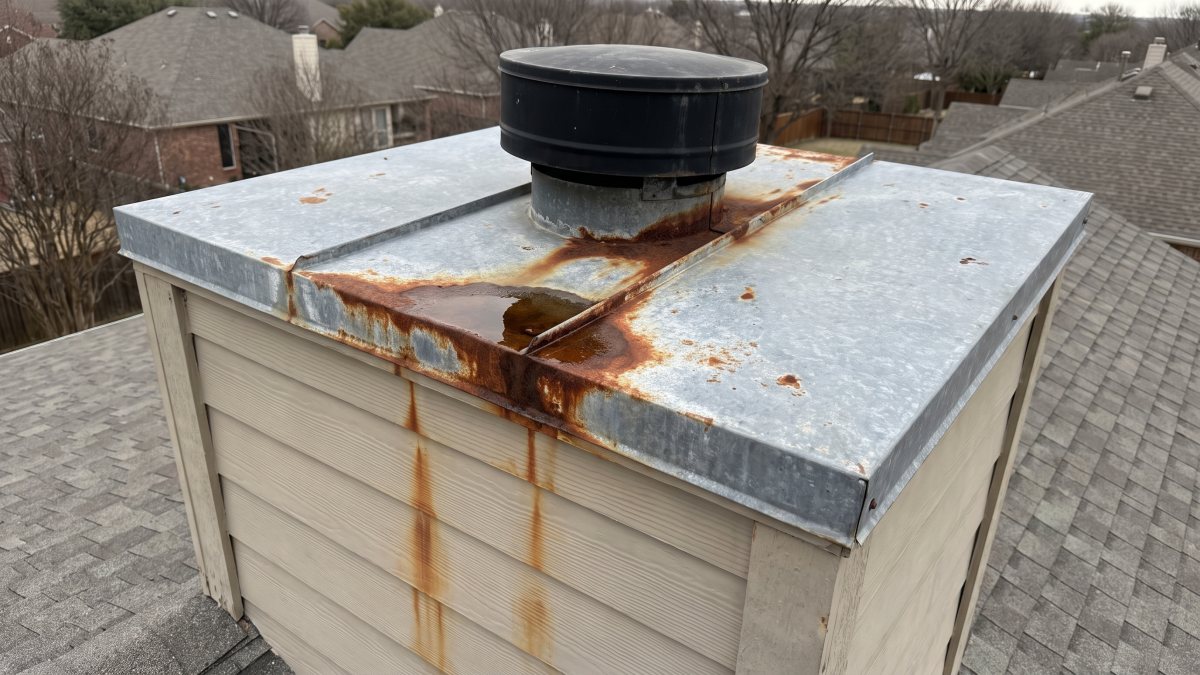
Almost every prefab chimney built in the northern suburbs through the 2000s left the factory with a galvanised chase cover, because it was the cheapest thing that met the spec. Galvanised steel protects itself with a zinc coating, and that coating gives up under North Texas conditions faster than most people expect. Relentless summer UV, hail two or three times a decade, and standing water sitting in a flat pan through a spring storm season all work on the same weak points.
What you get is rust starting at the seams and in whichever corner the pan sags toward, usually somewhere between year fifteen and year twenty. A house finished in 2006 is sitting right in that window now, which is most of the reason this is our busiest summer job.
Replacing galvanised with galvanised saves you two or three hundred dollars today and buys you the same fifteen years. Stainless costs more once and then stops being a line item. On a chase you plan to still own in a decade, the arithmetic is not close.
What it costs to leave it another year
A chase cover is a cheap part guarding an expensive assembly. Once the pan lets water through, it runs down inside a hollow timber box, and a prefab chase is timber framing, insulation and sheathing all the way down.
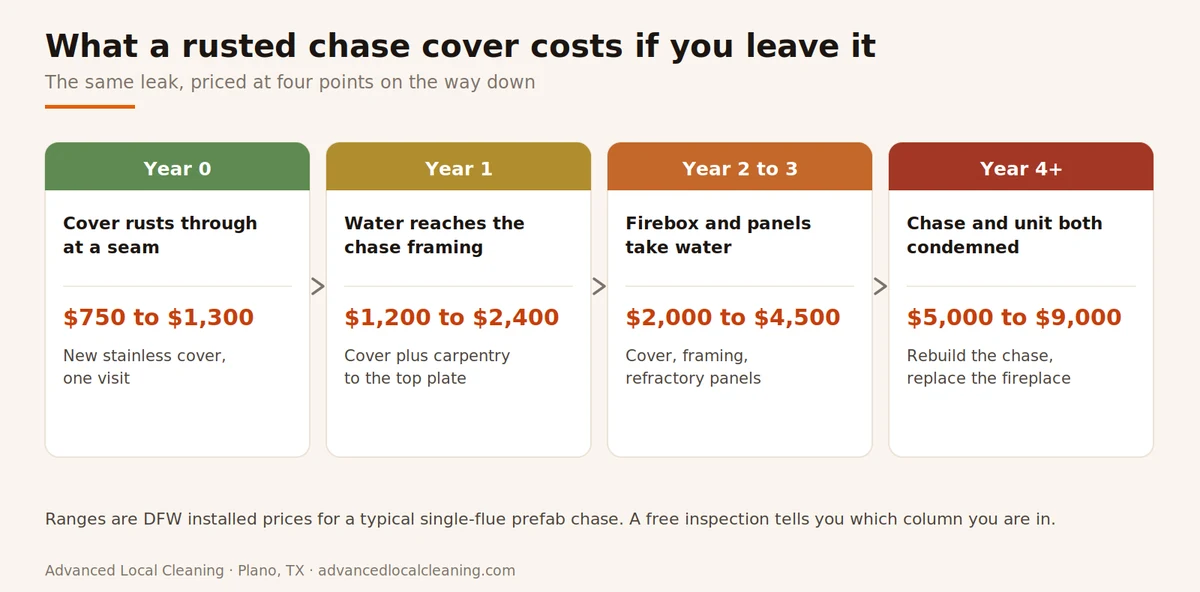
The uncomfortable part is that none of the early damage is visible from your living room. By the time a ceiling stain appears below the chase, water has usually been in the framing for a season or two. If you have rust streaks running down the siding, that is the warning, and it is a much cheaper warning than the drywall one. Our page on chimney leak repair covers the diagnosis if you are already seeing water inside.
What a proper replacement includes
Anyone quoting a chase cover should be doing all of this. If a quote is well under the ranges above, it is usually because one or more of these has been left out.
- The chase measured on the roof, not estimated from a photograph or a standard size
- A cover fabricated to those measurements, with a cross break so water sheds instead of pooling
- A skirt of at least three inches down all four sides, so wind-driven rain cannot get under the edge
- Flue collars cut to the actual pipe diameter and sealed with high-temperature sealant
- The old pan removed and taken away, and the top plate checked for rot while it is exposed
- The cap inspected and refitted, or replaced if it has corroded along with the pan. See chimney cap installation if yours needs doing at the same time
Five questions worth asking whoever quotes you
You do not need to know anything about sheet metal to ask these, and the answers separate a fabricated cover from a stock lid.
- Is it stainless or galvanised, and what gauge?
- Is it custom fabricated to my chase, or an off-the-shelf size?
- Does it have a cross break?
- How deep is the skirt?
- Is the cap included in that price, or extra?
Where this comes up most across the metroplex
The map for this job is really a map of when houses were built. The prefab chases hitting cover failure now went up between roughly 2000 and 2010, which puts them in Frisco, Allen, the newer McKinney additions, west Plano, Prosper and Little Elm. Older Richardson, Garland and east Plano are mostly masonry, so the equivalent conversation there is a crown rather than a cover.
If you can see rust from the ground, you already have the answer. We will get on the roof, photograph the pan, measure the chase and tell you what it needs before quoting anything, and the inspection does not cost you. You can read more about how we handle chase tops and covers, or see the full range of work we do.
Rust streaks on the siding? Get it measured before it gets expensive.
We photograph the chase top, measure it properly and give you the price in writing. Free inspection, no charge if the pan turns out to have life left in it. Based in Plano, working across DFW since 2013.
Common questions about chase cover replacement
Can a chase cover be repaired instead of replaced?
Occasionally, and only early. A single small pinhole in an otherwise sound pan can be sealed as a stopgap, usually to get a homeowner through to a planned replacement. Once rust has spread along a seam or opened a corner, sealant is buying weeks rather than years, because the metal around the patch is failing at the same rate. Most covers we look at are past the point where a repair is honest.
How do I know my chase cover is failing?
Rust streaks running down the siding or brick below the top of the chase are the earliest visible sign, and they are visible from the ground. After that comes water in the firebox after rain, a musty smell near the fireplace, staining on the ceiling or wall beside the chimney, and a cap that has worked loose. Any of those is worth a look before the next storm season.
Will insurance pay for a new chase cover?
It depends on the cause. Straightforward rust from age is wear and tear, and policies generally exclude it. Damage from a specific hail or wind event is a different question and is often covered, which is why photographs and dates matter. We document what we find either way so you have something to give an adjuster, though the decision sits with your carrier rather than with us.
Is a chase cover the same thing as a chimney cap?
No. The chase cover is the large flat pan covering the whole top of the chase. The cap is the small hood on the flue pipe that comes through it. They are different parts, different prices and different jobs, and they are often replaced together because the pan and the cap tend to corrode on the same timetable.
How long does the replacement take?
Measuring takes about twenty minutes on the roof. Fabrication is usually a few days because the cover is made to your dimensions. Fitting is a single visit of an hour or two for a standard single-flue chase, longer if the top plate needs carpentry or the roof needs staging.