
Chimney Rebuild vs Repair: How to Tell Which You Need
The signs that separate a repair from a rebuild, and what each one costs.
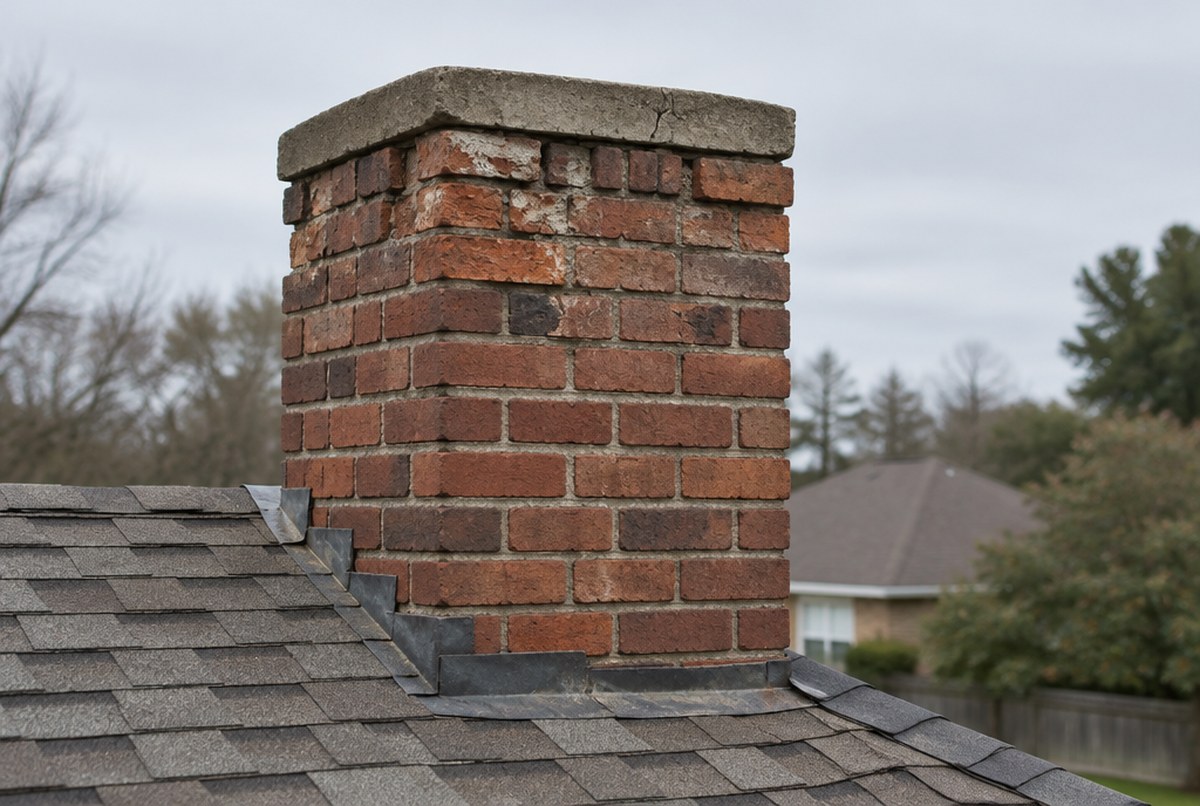
Repair a chimney when the damage sits in the mortar, crown, cap or flashing and the brick itself is still hard and straight. Rebuild when the brick is crumbling, the stack leans, or cracks run through brick and mortar together. Nationally, an average repair runs about $460 to $500, rebuilding just the part above the roofline about $1,000 to $4,000, and a full rebuild about $3,100 to $15,500. A rebuild costs more up front, but it can be cheaper than paying for the same patch every few years. We inspect first and quote the cheaper fix that will actually hold.
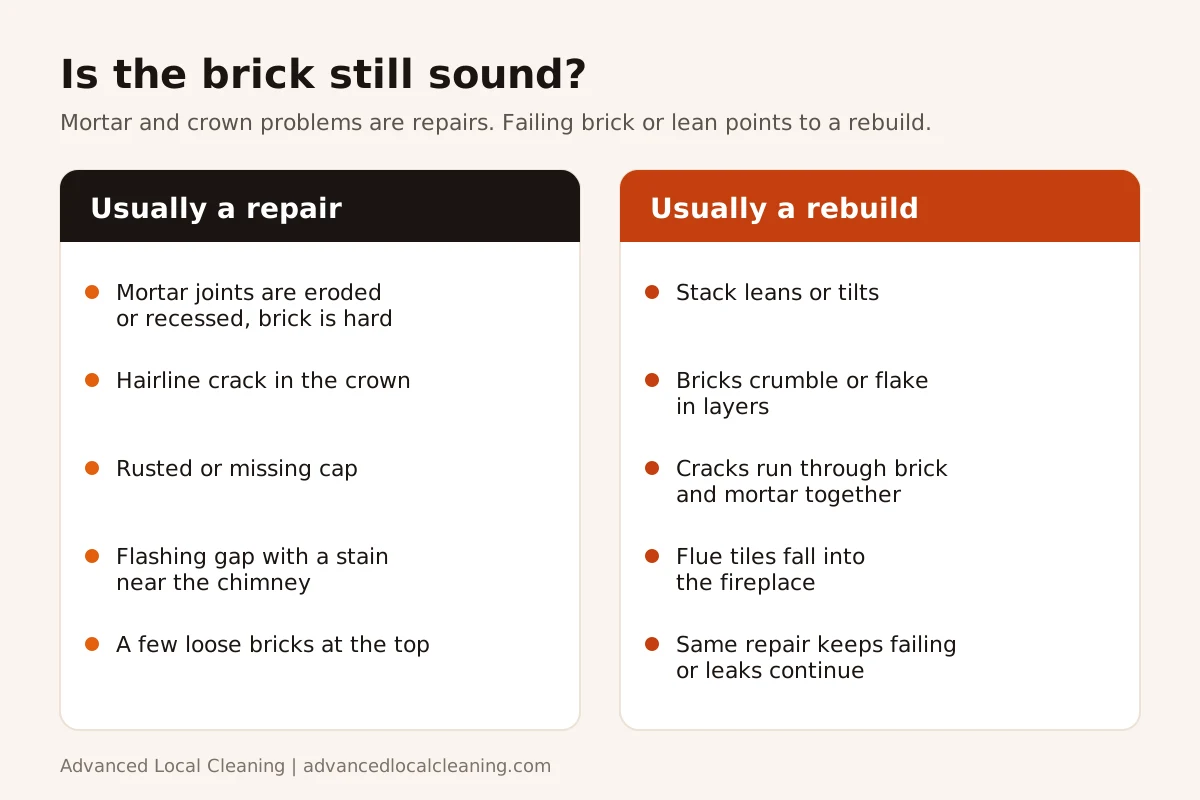
The question that settles it: is the brick still sound?
Mortar is softer than brick on purpose, so it wears out first. If the joints are eroded or cracked but the bricks are hard, square and level, the chimney is a repair candidate. If the bricks themselves are crumbling, flaking off in layers or sitting out of line, new mortar will not hold them and you are looking at a rebuild.
You can check a lot from the ground. Step back far enough to see the whole stack and look for lean, then use binoculars on the brick faces and the crown at the top. A stack that leans, even slightly, is a structural problem and not a cosmetic one.
Signs that point to a repair
Gray, powdery or recessed mortar joints are the most common one. They are fixed by masonry and tuckpointing, where the failed mortar is ground out and packed with new, color-matched mortar. Our guide to what tuckpointing is and when your mortar needs it shows what the joints look like at each stage.
A hairline crack in the concrete crown, a rusted or missing cap, a gap in the flashing with a brown stain on the ceiling nearby and a few loose bricks at the very top also count as repairs. Each one is a contained fix. If you are not sure which part is which, chimney cap, crown or chase cover sorts out the names. Our chimney repair page lists everything we repair and the work usually starts with a free inspection.
The catch is that most of these start with water. A cracked crown lets rain into the brick, and brick that stays wet through North Texas freeze and thaw cycles is the brick that eventually fails. A repair done early keeps a repair from becoming a rebuild.
Signs that point to a rebuild
Several signs say the masonry itself has failed:
The stack leans or tilts. Bricks crumble, chip or peel away in layers instead of just losing a little face color. Cracks run through the bricks and the mortar at once, often stepping down the stack in a zigzag. Pieces of flue tile fall into the fireplace. Water keeps showing up inside the house after you have already paid for a crown or flashing repair. Or the same section of the chimney has been patched more than once.
White staining called efflorescence is worth a mention, but it is not a verdict on its own. It tells you moisture is moving through the brick. Heavy staining on soft, flaking brick is a rebuild signal, while light staining on hard brick usually means the water source needs fixing. Our chimney rebuilding page explains how we take the masonry down to sound material and rebuild it, and we match the brick so the new work looks like it belongs.
Partial rebuild or full rebuild
A rebuild does not always mean the whole chimney. If the damage is above the roofline, which is the part of the stack you can see from the yard, the work can often stop there. The crew takes the stack down to sound masonry, relays it with new brick, and finishes with a new crown and a check of the flashing. The part below the roof stays.
A full rebuild goes further down, sometimes to the firebox or the foundation, and is the right call when the structure below the roof has moved, cracked or deteriorated. The way to find out is an inspection that includes the attic and the lower stack, not just a look from a ladder. A contractor who quotes a full rebuild after seeing only the top has not earned your trust yet.
What each option costs
Published national figures give a useful frame, even though they cannot account for a specific house. HomeAdvisor puts an average repair at about $460 and Angi at about $500. This Old House lists tuckpointing at $500 to $2,500 and crown repair at $750 to $1,000. For rebuilding above the roofline, HomeAdvisor shows $1,500 to $4,000 and Angi $1,000 to $3,000, rising past $5,000 on complex jobs. Full replacement runs $3,100 to $15,500 across the two, with averages of $9,300 to $10,000, and the largest jobs involving fire damage or a leaning stack can pass $20,000.
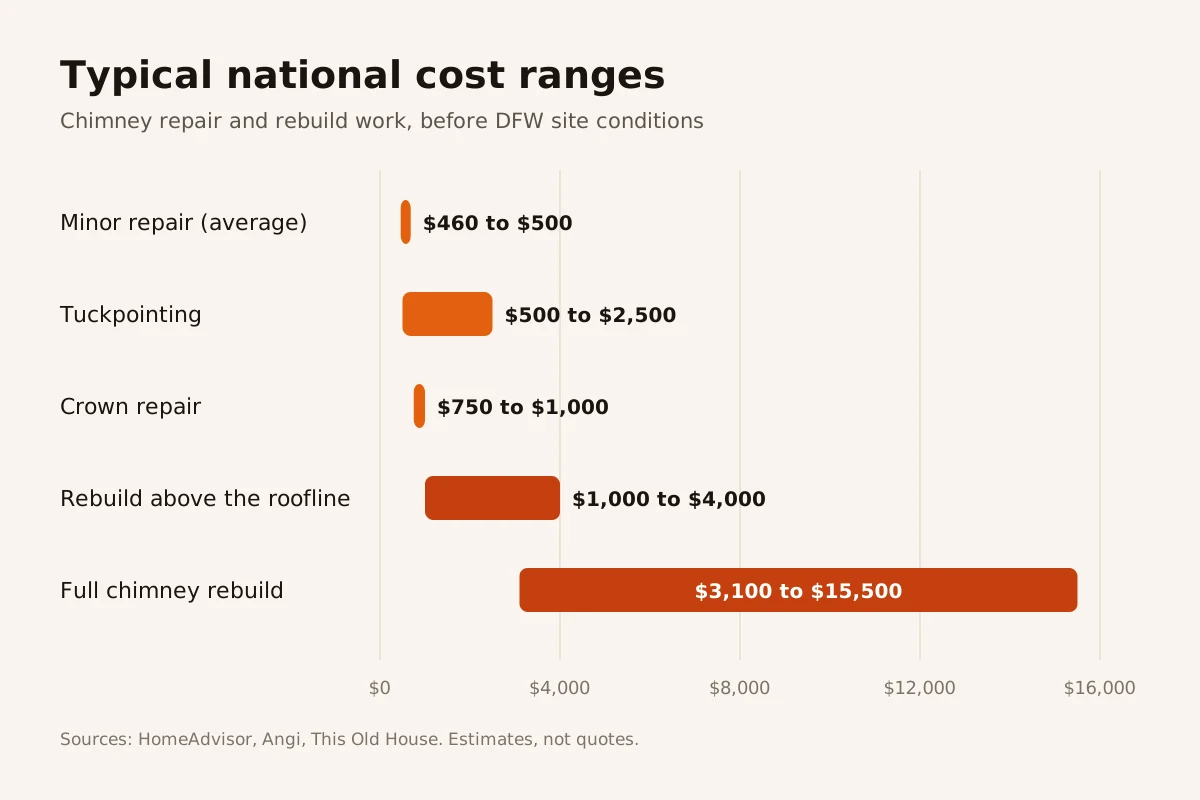
A few things move a rebuild price more than anything else. Height and roof pitch decide whether scaffolding is needed. The brick matters, since a close match to older brick costs more than common stock. A flue liner that has to be replaced adds a separate line, which This Old House puts at $1,200 to $4,600. And if the stack has to be raised to meet code, HomeAdvisor lists an extension at $500 to $3,000.
We do not post a flat price for rebuilds because the scope is not knowable until someone has looked at it. You get a written, itemized estimate after the inspection, with photos of what we found, and nothing starts until you say go.
When a repair is the wrong economy
Repairing is cheaper on the day, and that is exactly why it is easy to overdo. This Old House notes that a replacement can end up cheaper than several repairs spread over a few years. The practical rule is simple. If you have already paid to patch the same area twice, or the bricks are soft enough that new mortar will not bite, ask for a rebuild price next to the repair price and compare them honestly.
The opposite mistake happens too. A chimney with sound brick and tired mortar does not need a rebuild, and anyone who recommends one from the driveway is selling a bigger job than you need. Removing the stack down to the roofline is a third option some homeowners hear about, listed by This Old House at $500 to $2,500, but it ends the working fireplace, so treat it as a last resort.
Why North Texas chimneys reach this point
Dallas and Fort Worth swing from long hot summers to a handful of hard freezes each winter. Water that gets into a cracked crown or an open joint freezes, expands and pushes the surface off the brick, and then the next cycle goes deeper. Heat and sun also wear on mortar and flashing over the years. The result is that many chimneys here fail slowly, one cheap fix at a time, until a spring storm shows the leak that has been building for years. Our chimney leak repair and chimney crack repair pages cover the early stage, which is the cheapest time to act.
Code and permits on a rebuild
A rebuilt chimney has to meet the current code, and that is part of what you pay for. The familiar height rule is known as 3-2-10: the chimney must rise at least three feet above the point where it passes through the roof and at least two feet above anything within ten feet of it. Some cities also require a permit for structural masonry work, so ask your contractor whether yours does and who pulls it. Do not assume it is included in a low quote.
What the inspection should tell you
A good inspection answers three questions. Where is the damage, how far down does it go, and what is causing it. On our visits we look at the crown, cap, flashing, mortar joints and brick faces, check how the stack sits against the roof and photograph each problem so you can see it for yourself. Then we explain which parts need a repair, which need a rebuild and which can wait. If one section is failing and the rest is sound, we say so and price only that section.
It also helps to tell the inspector what you have noticed. A damp ceiling near the chimney after rain, bricks or mortar bits on the roof or in the yard, and a fireplace that smells worse in wet weather all point at where the water is getting in.
How to compare rebuild quotes
A rebuild quote is only comparable to another if the scope matches. Ask where the new masonry starts and stops, whether the crown, cap and flashing are included, and whether the flue liner is part of the price. Ask how they will match the brick, who handles scaffolding and what the warranty covers in writing. Ask what caused the damage, too. If the water source is not fixed, the new brick will fail the same way.
A trustworthy estimate comes with photos of the damage and an explanation of why it is a rebuild and not a repair. If someone cannot show you the problem, keep looking.
Get a straight answer on repair or rebuild
We inspect the chimney first, show you photos of what we find and tell you whether a repair will hold or a rebuild is the smarter money. The estimate is written and itemized, and nothing starts until you approve it. Based in Plano, working across DFW since 2013.
Common questions about chimney rebuilds
How much does it cost to rebuild a chimney?
Nationally, a full rebuild runs about $3,100 to $15,500, with averages near $9,300 to $10,000. Rebuilding only the stack above the roofline is usually about $1,000 to $4,000. We quote after an inspection.
Can you rebuild just part of a chimney?
Yes. If the damage is above the roofline and the masonry below is sound, the stack can be taken down to solid brick and rebuilt without touching the rest.
How do I know if my chimney needs a rebuild instead of tuckpointing?
Tuckpointing fixes failed mortar around sound brick. If the bricks themselves are crumbling, the stack leans or cracks run through brick and mortar, a rebuild is the safer call.
Is there a chimney rebuild company near me in DFW?
We are based in Plano and rebuild chimneys across the Dallas Fort Worth area. The inspection is free and comes with photos and a written estimate.
Does a rebuilt chimney have to meet current code?
Yes. That includes the 3-2-10 height rule, and some cities require a permit for structural masonry work. Ask your contractor to confirm for your city.