
Spalling Brick on a Chimney: Why North Texas Freeze-Thaw Does This
What spalling is, why freeze and thaw causes it, and when it means a repair or a rebuild.
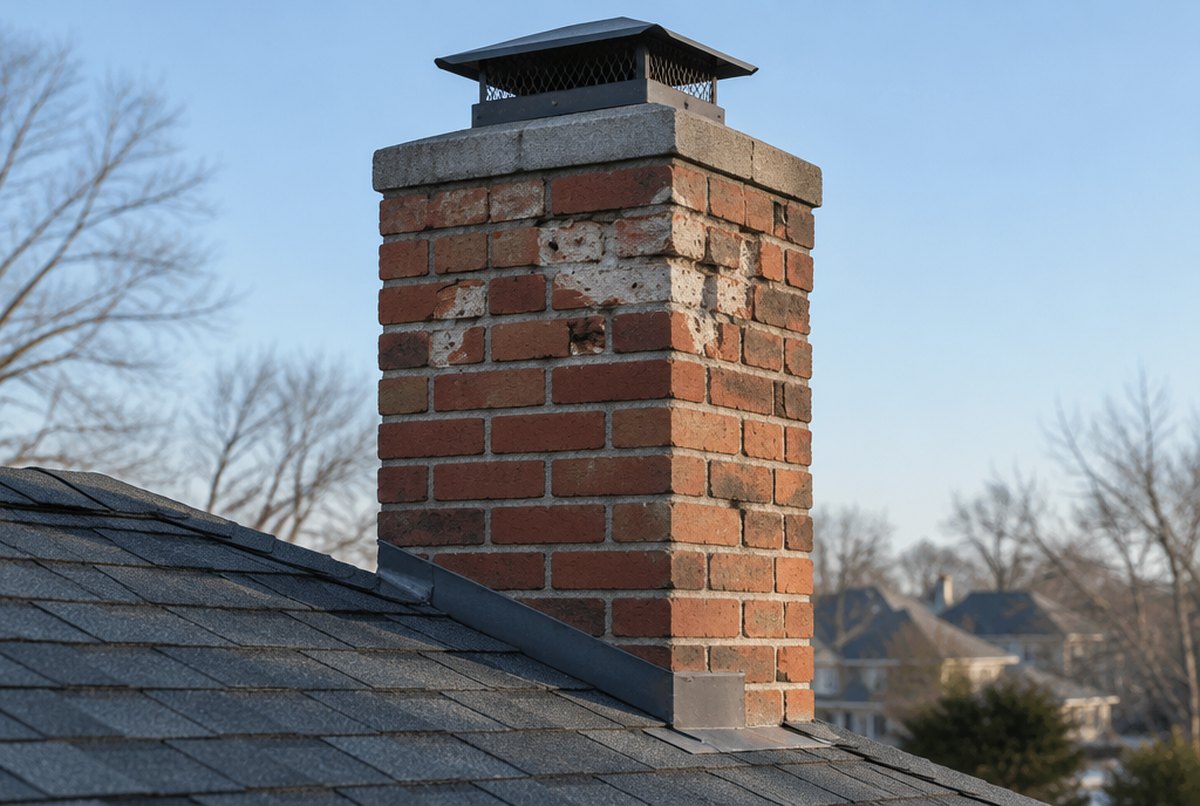
Spalling is when the outer face of a brick flakes, peels or pops off and leaves a rough, pitted surface behind. On North Texas chimneys it is almost always water at work: rain soaks into the brick, a freezing night turns it to ice, and the expanding ice pushes the face off. A few spalled bricks can be replaced and the joints repointed for a few hundred dollars nationally. Widespread spalling, brick that crumbles in your hand or a stack that leans means the masonry is failing and that section needs a rebuild. Either way, fix the water source first, or the new brick will fail the same way.
What spalling looks like
A spalled brick has lost its skin. The hard, fired outer face has flaked, peeled or popped off, and what is left behind is a pale, rough, pitted surface that is softer than the original. You often see it first as small orange chips on the roof, in the gutters or in the flower bed below the chimney, and then as patches on the stack where the brick color changes from deep red to dusty tan.
It tends to start near the top. The upper few feet of a chimney get the most rain, the most wind and the most cold, and they get no warmth from the house. They are also where a cracked crown or a failing mortar joint lets water in. Spalling lower on the stack, close to the roof, often points at the flashing or at water running down the brick face.
Why North Texas chimneys spall
Brick is porous. It drinks in rain and releases it slowly as it dries, and that is fine as long as the water leaves before the temperature drops. When a freezing night catches brick that is still wet, the water inside turns to ice and expands by roughly nine percent. The ice has nowhere to go but out, so it pushes the outer layer of the brick off. Each thaw lets more water reach the softer brick that was just exposed, and the next freeze goes deeper.
Dallas and Fort Worth do not have long winters, but they have the exact pattern that does the most damage: a warm, damp afternoon followed by a hard freeze after dark. A deep freeze like the one in February 2021 is the kind of event that finishes off masonry that was already holding water.
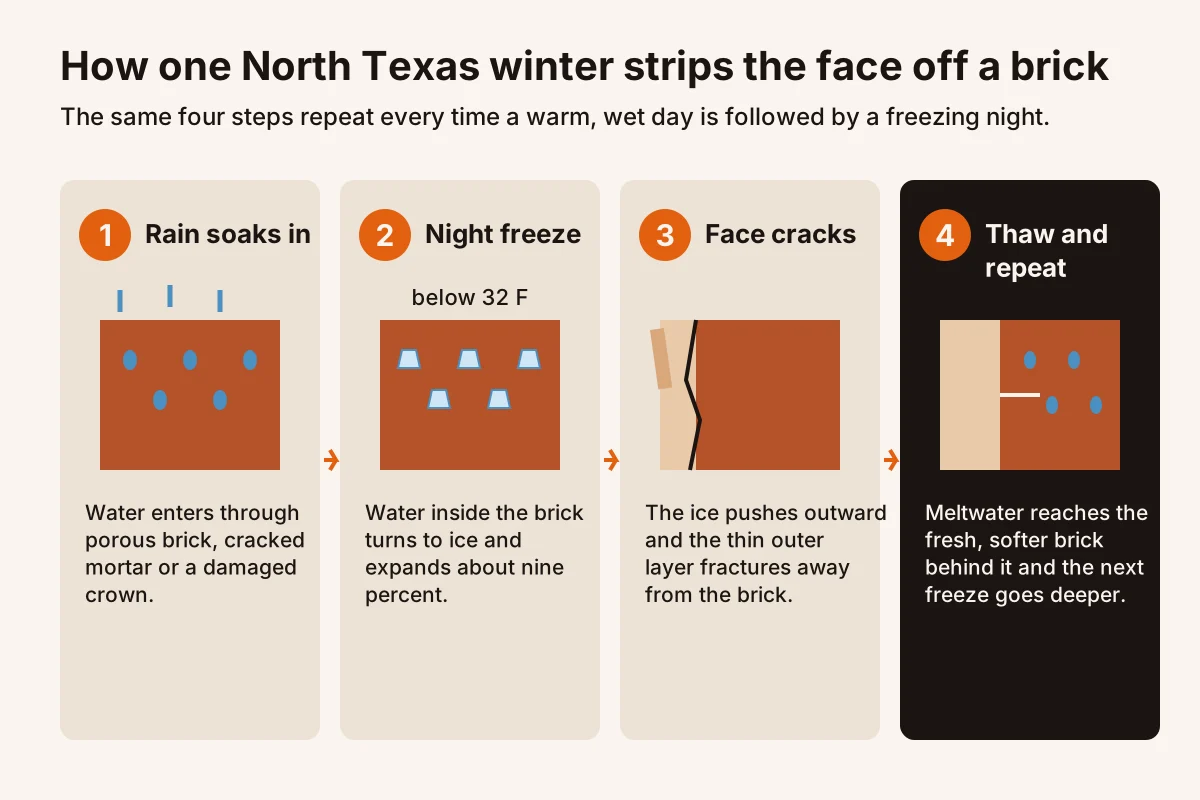
Water is the cause, but something has to let it in. The usual suspects are a cracked or crumbling crown, mortar joints that have eroded, flashing that has pulled away from the brick, and a missing or undersized cap. Older, softer brick absorbs more water than modern brick, which is why a house from the 1960s or earlier often spalls first. Repointing with a mortar that is harder than the brick can also trap moisture in the wall, so it has to leave through the brick face instead.
If only one or two bricks are spalling while the rest of the stack looks fine, a soft brick that slipped into the batch during the original build is a likely reason. If the damage is spread across the stack, the brick was probably not the problem. Something is feeding water to the whole chimney.
Is a spalling chimney dangerous?
Usually it is not an emergency, but it is not cosmetic either. Every spalled brick lets in more water than a sound one, so the damage speeds up. Water that gets through the masonry can reach the flue, the firebox and the ceiling around the chimney, and you may see it as stains, a musty smell after rain or white powder on the brick called efflorescence.
The one real hazard is loose pieces. Bricks that have lost most of their face can shift, and chunks at the top of a stack can fall onto a roof, a deck or a walkway. If you can see bricks that look ready to drop, keep people and pets away from that side of the house and have someone look at it soon.
How bad is it? A simple severity scale
The number of spalled bricks matters less than how deep the damage goes. Three levels cover most chimneys.
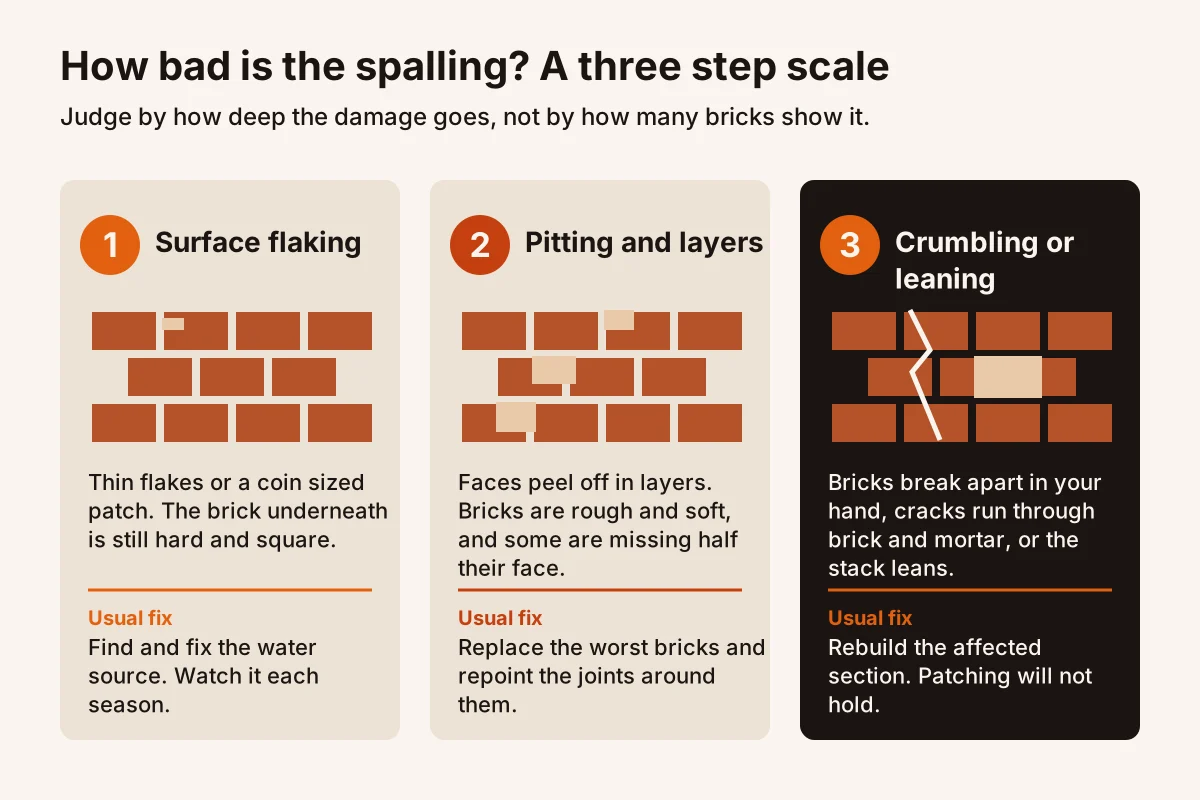
At the first level the face has flaked in small pieces but the brick underneath is hard and square. The brick is not the priority here. Finding the water source is. Seal a cracked crown, fix the joint above the patch and watch the area through the next winter.
At the second level the faces peel in layers, the brick is rough and soft, and some bricks have lost half of their thickness. A common rule among repair companies is that a brick with more than half of its face gone should be replaced. This is the stage where individual bricks are cut out and new ones set in, and the mortar around them is repaired.
At the third level the brick comes apart in your hand, cracks run through bricks and mortar together, or the stack leans. That is a failing structure. New mortar will not hold in brick this soft, and the right call is to rebuild the affected section.
What the repair involves
A proper fix has three parts, and skipping any of them is how a repair fails within a couple of winters.
The first is the water source. We look at the crown, the cap, the flashing and every joint above the damage. A cracked crown is a short job on our chimney crown repair page, and a new cap or chase cover keeps rain off the top of the stack. If you are unsure which part is which, chimney cap, crown or chase cover lays out the differences.
The second is the brick and mortar. Bad bricks are chiseled out and replaced with new brick that matches the color and texture as closely as possible, and the surrounding joints are repointed with a mortar that is not harder than the brick. Our masonry and tuckpointing service covers this work, and what chimney tuckpointing is and when your mortar needs it explains how failing joints and spalling often show up together.
The third is protection. Once the repairs have cured, a breathable water repellent can slow down how much rain the brick absorbs while still letting it dry out. Avoid a coating that seals the surface and traps water behind it, which just moves the spalling somewhere else. Our chimney repair page lists what we handle on a typical visit.
When spalling means a rebuild
Replace individual bricks when the damage is scattered and the rest of the masonry is sound. Rebuild when the spalling covers a large part of the stack, when bricks are soft enough to crumble, when cracks step through the wall or when the same area has been patched more than once. A partial rebuild from the roofline up is often enough, which is a smaller job than most people expect. Our chimney rebuilding page explains how it works, and chimney rebuild vs repair goes through the decision in more detail.
What it costs
Local prices depend on height, roof pitch and brick, so the figures below are national ranges from published cost guides and not quotes. Replacing bricks over a small area usually runs about $250 to $450, and larger areas of up to 100 square feet about $1,000 to $3,000. Repointing the joints runs $5 to $25 per square foot, and tuckpointing a chimney overall about $500 to $2,500. Rebuilding above the roofline is typically $1,000 to $4,000, and a full rebuild $3,100 to $15,500.
Chimneys sit on the high end of any brick range because the work happens on a roof. Scaffolding, a steep pitch and hard to match older brick all add to the price. We give a written, itemized estimate after an inspection, and nothing starts until you approve it.
Can you fix it yourself?
Swapping a single brick on a garden wall is a weekend job. On a chimney it means working on a roof with a chisel and wet mortar, so it is rarely worth the fall risk. What you can do safely from the ground is watch. Take a photo of the stack from the same spot each fall and spring with a zoom lens, and compare. If patches grow or new ones appear, that tells you more than any single look.
When to have it looked at
Late fall is a good time to check, before the first hard freeze and while the weather still allows masonry work. Mortar needs mild temperatures to cure, so repairs done in a cold snap are a poor bet. Book an inspection if you see flakes on the ground, tan patches on the stack, stains on the ceiling near the chimney or any brick that looks loose. A free look now is cheaper than the same job after a winter of freeze and thaw has taken it further.
Have your chimney brick checked before the freeze
We inspect the stack, show you photos of what we find and tell you whether a few bricks need replacing or a section needs rebuilding. The estimate is written and itemized, and nothing starts until you approve it. Based in Plano, working across DFW since 2013.
Common questions about spalling brick
What causes brick to spall on a chimney?
Water soaks into the brick and freezes. The ice expands and pushes the outer face off, and each freeze and thaw cycle goes deeper. A cracked crown, worn mortar or failed flashing usually lets the water in.
Can spalled brick be repaired?
Yes, when the damage is limited. Bricks that have lost most of their face are cut out and replaced, and the joints are repointed. Brick that crumbles throughout needs a rebuild of that section.
How much does it cost to fix spalling brick?
National guides show about $250 to $450 for a small area and $1,000 to $3,000 for up to 100 square feet. Chimneys cost more because of roof access. We give a written estimate after an inspection.
Is a spalling chimney dangerous?
It is rarely an emergency, but it lets more water into the masonry and loose pieces can fall from the top of the stack. Have it checked before the next hard freeze.
Should I seal spalled brick?
Only after the repairs, and only with a breathable water repellent. A coating that traps moisture behind the brick can make spalling worse.