
What Chimney Tuckpointing Is and When Your Mortar Needs It
The difference between tuckpointing and repointing, the two tests that tell you which repair your chimney needs, and what the job costs in North Texas.
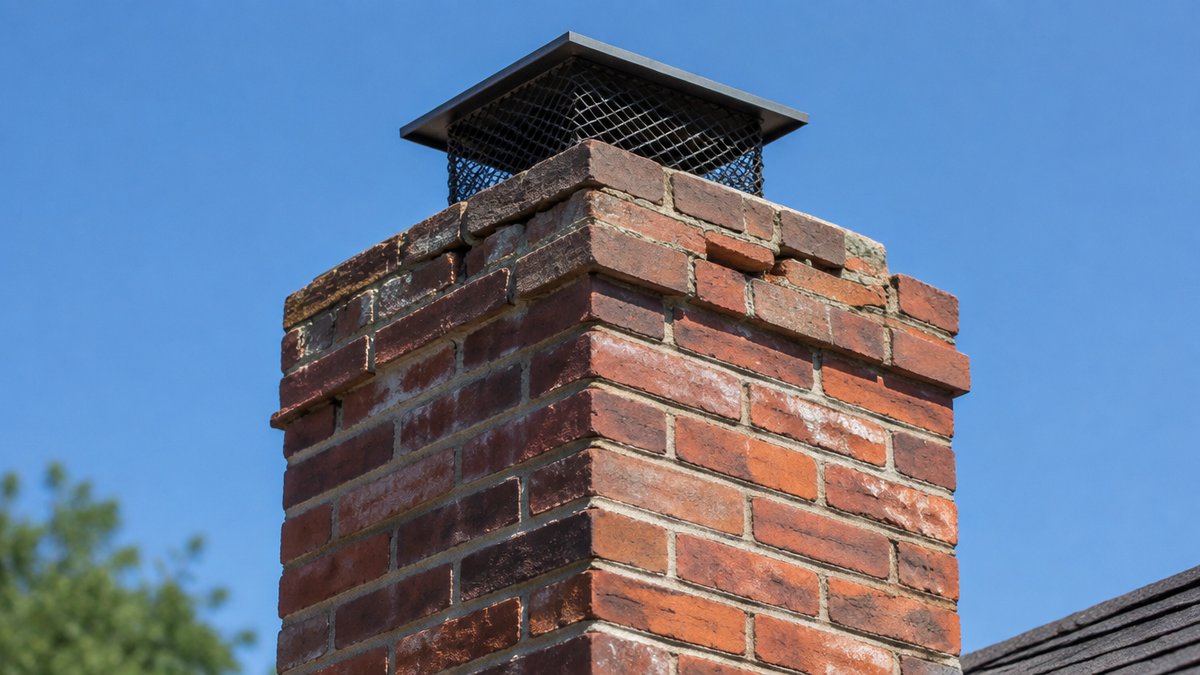
Tuckpointing is grinding out old, failed mortar between bricks and packing in fresh mortar to restore the joint's strength and its seal against water. Technically, tuckpointing means a decorative version of this repair that lays a thin contrasting line into new mortar, while repointing is the plain structural version that just matches what is already there. In North Texas almost everyone, including most contractors, uses tuckpointing to mean either one. What actually decides which repair you need is depth, not looks: a joint that only scratches under a screwdriver usually needs a cosmetic refresh, while one that lets the screwdriver sink in past a fingernail's depth needs a full repoint. A standard one-story chimney runs $500 to $2,500. A two-story or badly damaged stack runs $5,000 to $7,000.
What tuckpointing actually means
Every masonry chimney is really two materials doing two different jobs. The brick carries the load and takes the weather on its face. The mortar between the bricks does the quieter work of holding the whole stack together and keeping water from tracking into the wall behind it. Mortar is the weaker of the two on purpose, it is meant to wear out before the brick does, so a homeowner never has to replace bricks just because a joint failed. Tuckpointing is the repair that resets that clock: a technician grinds out the failed mortar to a consistent depth, cleans the joint, and packs in fresh mortar matched to the original in color and hardness so the repair reads as part of the stack rather than a patch.
On our own jobs across Dallas-Fort Worth, a mortar joint that was installed correctly holds up 25 years or more before it needs this kind of attention. What ends that lifespan early is almost always water. A failed crown, a loose cap, or bad flashing lets rain sit against the brick longer than it should, and North Texas freeze-thaw swings turn that trapped moisture into cracks a lot faster than the mortar would otherwise wear out on its own.
Signs you can spot without climbing a ladder
Most homeowners do not go looking for mortar problems until something else tips them off. A few signs show up from the ground or inside the house well before the joints look obviously bad up close.
- White, chalky staining on the brick face, called efflorescence, means water is moving through the masonry and leaving mineral deposits behind as it evaporates.
- Small chips or grit collecting on the roof below the chimney, or in the gutter nearest it, often mean mortar is breaking down and shedding material a piece at a time.
- A damp or musty smell from the fireplace that was not there before can mean water is tracking down through failed joints toward the firebox.
- Visible gaps between bricks near the top course, the kind you can make out from the yard without binoculars, usually mean the joint has already opened up more than a hairline crack.
None of these tell you exactly which repair you need on their own, but any one of them is a reason to get an actual look at the joints rather than waiting for a leak to show up somewhere more obvious.
Tuckpointing vs. repointing: is there really a difference
Strictly, yes. Historic tuckpointing used two mortar colors, one matched to the brick as a base coat, then a thin contrasting line, often lime putty, tooled into a narrow groove on top of it. The effect made ordinary joints look like the finer, hand-cut joints of old rubbed-brick masonry. Repointing skips the decorative line entirely and just replaces failed mortar with new mortar flush to the brick face, aimed at strength and weathertightness rather than appearance.
In practice, almost nobody in North Texas draws that line. Homeowners search "tuckpointing," contractors quote "tuckpointing," and the job that gets done is the structural repoint, not the two-tone decorative version. We use the same convention on this page. If you specifically want the old two-color look on a historic home, say so when you call, since it is a different scope than a standard structural repair and priced separately.
The mortar test: how to tell what your chimney needs
You do not need a contractor on the roof to get a first read on your mortar. Two simple checks, done from a ladder on a few joints near the top of the stack where weather hits hardest, tell you most of what you need to know.
Rub a joint with your finger. Mortar in good shape stays solid. Mortar that is failing turns sandy or flakes off under light pressure. Then press a screwdriver tip into the same joint. Sound mortar only scratches the surface. Failing mortar lets the tip sink in, and how far it sinks tells you how far along the failure is.
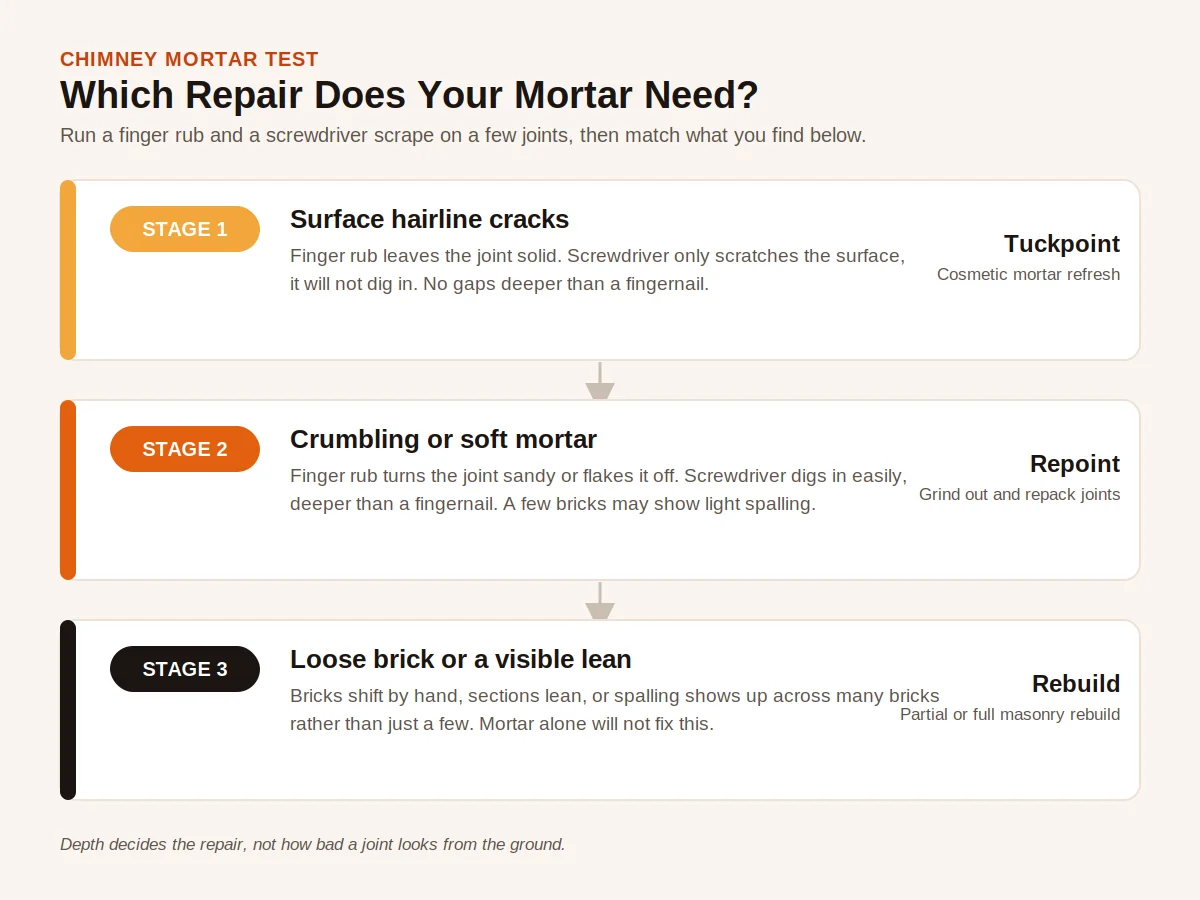
Surface hairline cracks with mortar that stays solid under both tests usually only need a cosmetic refresh at the joints affected. Mortar that crumbles, feels sandy, or lets the screwdriver dig in deeper than a fingernail's depth means the joint has actually failed and needs a full repoint, not a surface patch. If you also see bricks that shift by hand, a section of the stack leaning, or spalling, brick faces flaking or peeling, spread across many bricks rather than just a few, mortar work alone will not fix the problem. That combination points toward a partial or full rebuild instead, and our chimney crack repair team can tell you which side of that line your chimney is on during a free inspection.
What a professional tuckpointing job involves
A proper repoint starts with removing the failed mortar to a controlled depth, roughly twice the height of the joint, without cutting deeper than about a third of the total joint depth. Go shallower and the new mortar will not bond well enough to last. Go deeper and you risk loosening the surrounding brick, which turns a mortar job into a brick replacement job. Getting that depth right by feel, on a ladder, on a hot roof, is most of why this is not a great weekend DIY project.
Mortar type matters as much as depth. Most American brick built after 1900, which covers the overwhelming majority of DFW housing stock, calls for Type N mortar. A stronger mix sounds like the safer choice but is not: mortar that is harder than the surrounding brick does not flex with normal temperature movement, and it can crack the brick faces around it instead of absorbing that movement itself. After the new mortar goes in, it needs to cure slowly, typically covered and lightly misted for about a week, so it does not dry out and crack before it has set properly.
Why a tube of caulk isn't the fix
Caulking over a cracked joint is the most common shortcut homeowners try before calling anyone, and it is understandable, since a tube of exterior caulk costs a few dollars and the job takes ten minutes. The problem is that caulk seals the surface without doing what mortar does. It does not bond to brick the way mortar does, it does not restore the joint's strength, and on a masonry chimney it usually fails within a season or two of North Texas heat and freeze-thaw cycling.
The bigger issue is what happens while it is still holding. Caulk applied over a joint that has already started failing can trap moisture behind it instead of letting the wall dry out the way it is supposed to, which sometimes speeds up the damage it was meant to stop. If a joint is bad enough to reach for a caulk gun, it has already crossed the line into needing real mortar, not a sealant.
What tuckpointing costs by job size
Pricing on mortar repair scales with how much of the stack needs work and how hard it is to reach, not with a flat per-job rate. A standard one-story chimney with straightforward access typically runs $500 to $2,500 for a full repoint. A two-story home, a chimney with a steep or difficult roofline, or a stack with damage spread across most of its joints runs $5,000 to $7,000, mainly because of the added scaffolding and labor time rather than the mortar itself.

On larger commercial or multi-flue jobs, contractors sometimes bill by the square foot instead of a flat project price, typically $8 to $30 per square foot depending on height and access. A smaller number bill by the row of brick affected, usually $20 to $50 per row. Whichever method your quote uses, ask what it actually covers, since surface prep, mortar matching and cleanup are sometimes itemized separately rather than bundled into the headline number.
When tuckpointing isn't enough anymore
Mortar work has a ceiling. If the underlying brick has cracked, spalled across multiple courses, or a section of the chimney has started to lean, repointing the joints will not address what is actually wrong, because the problem has moved from the mortar into the brick and the structure itself. Waiting past that point does not save money. It just lets water keep working into a stack that already needs more than a repointing crew can fix in one visit.
The reverse mistake costs more, though: treating every crack as a rebuild-level problem when a same-day repoint would have solved it. That is why we inspect before we quote. A technician on the roof can tell within a few minutes whether your chimney needs a $500 refresh, a $5,000 repoint, or a conversation about a rebuild, and there is no charge for finding out which one applies to you.
Not sure if your mortar needs a patch or a full repoint?
We will get on the roof, run the same tests covered above, and tell you plainly what your chimney needs before anyone touches a grinder. Based in Plano, working across DFW since 2013.
Common questions about chimney tuckpointing
Is tuckpointing the same thing as repointing?
Not strictly. Tuckpointing traditionally means a decorative two-color mortar joint. Repointing is the plain structural repair. Almost everyone, including most contractors, uses tuckpointing to mean the structural repair, and that is the job most homeowners are actually asking for.
How long does chimney tuckpointing last?
A correctly done repoint typically lasts 25 years or more before it needs attention again. How long yours actually lasts depends on whether the underlying cause, usually water getting in from a failed crown, cap or flashing, gets fixed at the same time.
Can I tuckpoint my own chimney?
You can test the mortar yourself with a finger rub and a screwdriver scrape, but the repair itself is harder to get right than it looks. Grinding to the correct depth without loosening surrounding brick, and matching mortar type and hardness to what is already there, is easy to get wrong on a first attempt and hard to fix afterward.
How do I know if I need tuckpointing or a full chimney rebuild?
Surface hairline cracks that stay solid under a finger rub and a screwdriver scrape usually need only a cosmetic refresh. Crumbling or sandy mortar needs a full repoint. Loose brick, a visible lean, or spalling spread across many bricks means the problem has moved past mortar and into the structure, which points toward a rebuild.
Does tuckpointing fix a chimney leak?
Sometimes, but not always. If water is getting in through failed mortar joints, repointing seals that path. If the actual source is a cracked crown, damaged flashing or a bad cap, repointing the mortar will not stop the leak until that source gets fixed too.