
How Often Should You Clean a Dryer Vent?
The short answer is once a year for most homes. What actually moves that number is laundry volume, vent length and where the duct terminates.
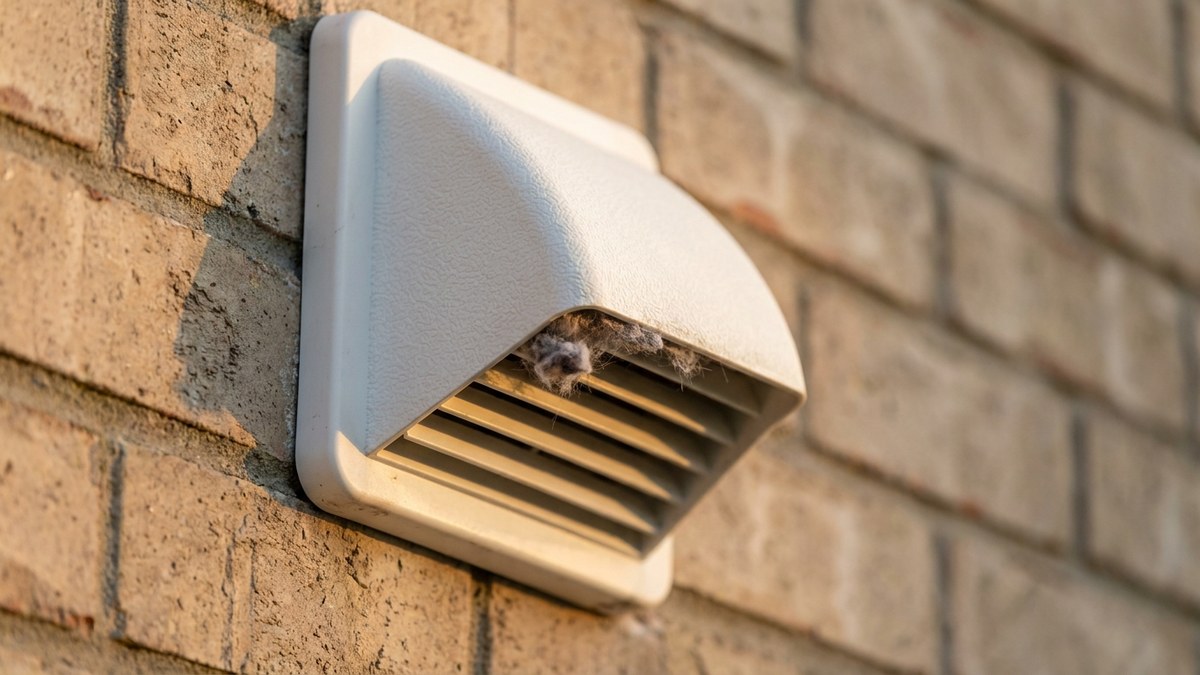
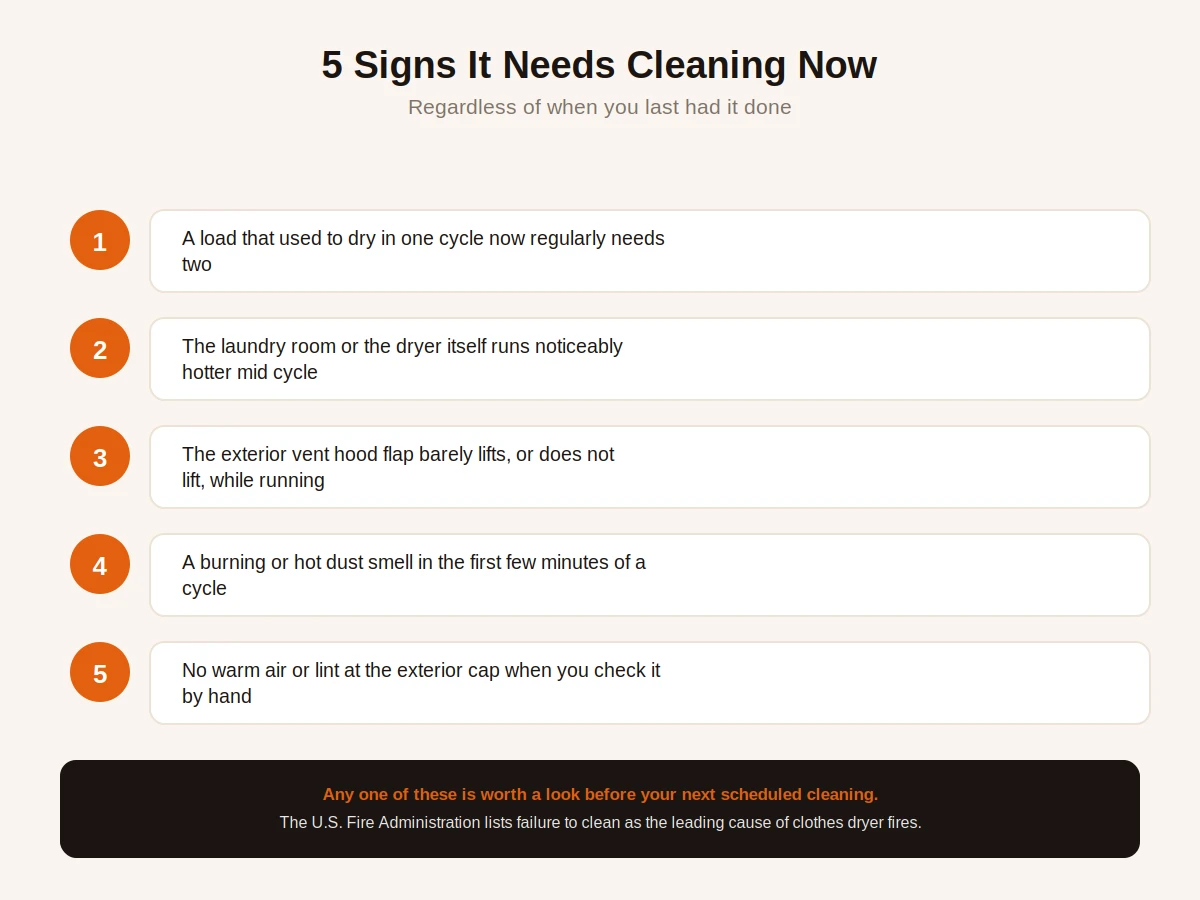
Most homes need a professional dryer vent cleaning once a year. Push that to every six to nine months if you run more than eight loads a week, have a shedding pet, or vent through a long attic run to a roof cap instead of a short wall cap. A one or two person household with a short, straight wall vent and light laundry can often stretch to 18 to 24 months. The U.S. Fire Administration still lists failure to clean as the leading cause of clothes dryer fires, so treat that outer limit as a ceiling, not a target. If a load is taking two cycles to dry, the laundry room runs warmer than usual mid cycle, or the exterior vent hood barely moves when the dryer runs, clean it now regardless of the calendar.
The three things that actually set your schedule
Every generic answer to this question lands on "once a year," and for a lot of households that is close enough. Three details push a specific home off that average in either direction, and none of them have anything to do with how new the dryer is.
- How many loads you run each week, and what is in them. Towels, bedding and anything covered in pet hair shed more lint per load than a mixed load of everyday clothing.
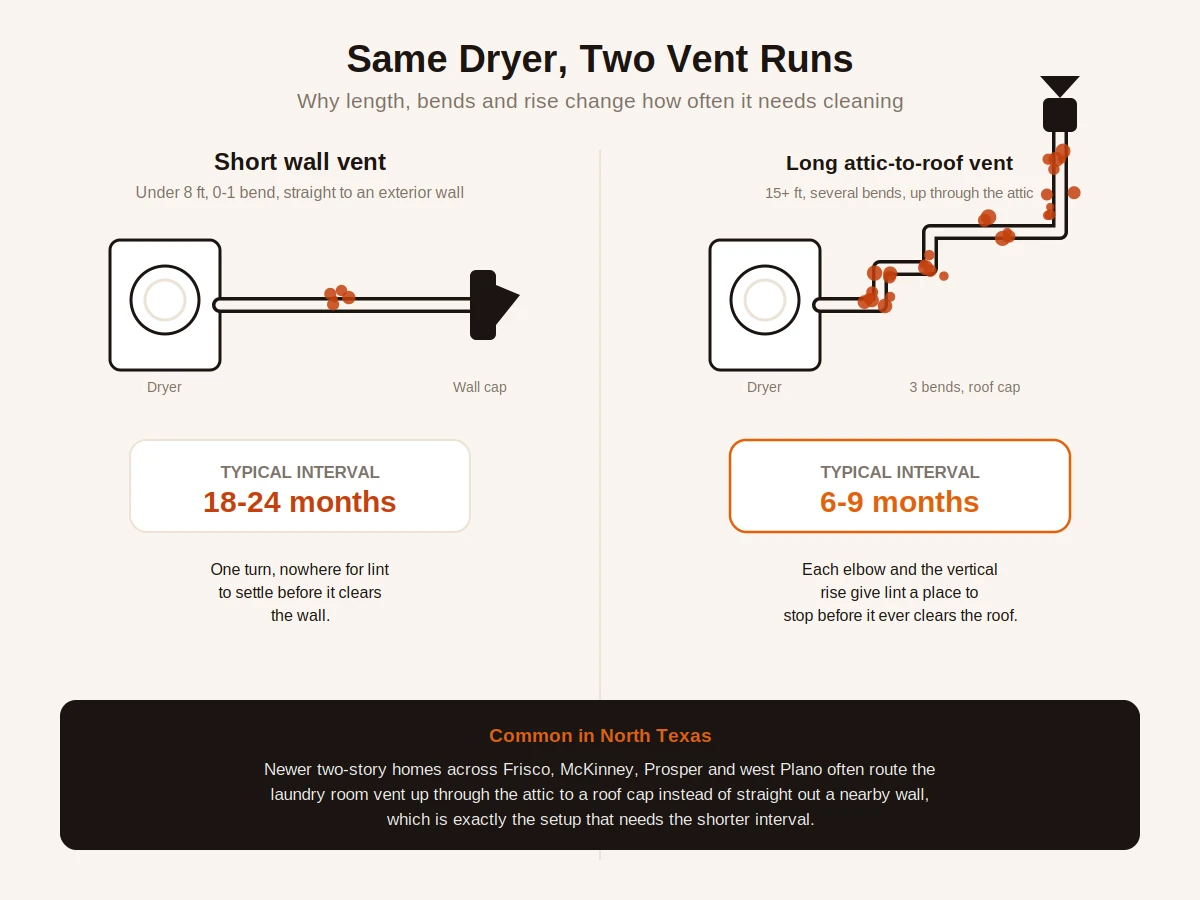
- How long the vent run is and how many bends it takes to get outside. A run with two or three 90 degree turns collects lint at each turn the way a straight shot never does.
- Where it terminates. A wall cap a few feet from the dryer clears itself far more easily than a run that climbs through an attic and exits a roof cap, where lint has gravity working against it on the way out.
How often, by household and vent setup
These are starting points based on how the three factors above typically combine in a real home, not a guarantee for any specific house.
| Household and vent setup | Typical loads per week | Recommended interval |
|---|---|---|
| 1 to 2 people, short wall vent (under 8 ft, 0 to 1 bend) | 3 to 5 | Every 18 to 24 months |
| 3 to 4 people, average wall vent (8 to 15 ft, 1 to 2 bends) | 6 to 9 | Every 12 months |
| Shedding pet in the home, or a 2-story house venting through the attic to a roof cap | 6 to 10+ | Every 6 to 9 months |
| Daily laundry, heavy fabrics, or a multi-family or rental unit | 10+ | Every 6 months, regardless of run |
A short, straight vent that has never been cleaned since the home changed hands can still be packed with years of lint, and a long attic run that was serviced six months ago does not reset to a two year clock just because the setup is difficult. When in doubt, a technician can tell you exactly where your vent stands in about the time it takes to clean it.
Why vent length and bends matter more than most homeowners expect
Lint does not fall out of moving air on its own. It needs somewhere to slow down and settle, and every 90 degree elbow in a vent run does exactly that, well before the rest of the duct is anywhere near full. Two or three elbows can functionally cut a vent's usable capacity by half compared to the same length of duct run in a straight line.
Vertical runs add a second problem. Warm, moist air wants to rise, which helps on the way up, but any lint that does not make it all the way out has to fight gravity instead of settling somewhere along the way down. A roof termination, common on two-story North Texas builds with an upstairs laundry room, routes the vent up through the attic and out through the roof deck instead of straight out a nearby wall, which is why those setups land on the shorter end of the interval table above.
The flexible hose connecting the dryer to the wall is its own weak point. Foil and vinyl transition hose kinks more easily than rigid metal duct, and its ridges catch lint that the smooth wall of a rigid pipe would not. If yours is more than a few years old, ask a technician whether it is worth swapping for rigid or semi-rigid metal while they are already back there.
What this looks like in North Texas specifically
A lot of the newer construction across Frisco, McKinney, Prosper and west Plano puts the laundry room upstairs rather than off the garage, which means the vent run has to clear the attic and the roof deck instead of ducking straight out a nearby wall. A North Texas attic regularly climbs well past 120 degrees through the summer, and a termination hood and duct that spend months baking up there before the vent gets used again in cooler weather can warp a plastic damper flap or crack an aging flexible section without anyone noticing until wash day.
Older single-story homes across Plano, Carrollton and Richardson tend to have the opposite setup: a short wall vent a few feet from the laundry room, which is the best case in the table above. The home's history matters too. A vent that has never been cleaned since a house changed hands, even a short one, is a common and avoidable finding on a first inspection.
The U.S. Fire Administration attributes about a third of clothes dryer fires nationally to failure to clean the vent, more than any other single cause, and puts the annual toll at roughly 2,900 home fires, 5 deaths and $35 million in property damage. None of that requires an unusual setup. It just requires an interval that ran longer than it should have.
Signs your vent is overdue, no matter what the calendar says
A handful of signals mean stop waiting for your usual schedule.
- A load that used to dry in one cycle now regularly needs two
- The laundry room or the dryer itself runs noticeably hotter mid cycle
- The exterior vent hood flap barely lifts, or does not lift at all, while the dryer is running
- A burning or hot dust smell in the first few minutes of a cycle
- No warm air or visible lint at the exterior cap when you check it by hand during a load
- A musty smell or a scratching sound from the duct, which usually means something other than lint got in
What a professional cleaning resets
A proper dryer vent cleaning clears the duct from the connection at the back of the dryer to the exterior termination, not just the few feet you can reach yourself, and finishes with an airflow check at the cap to confirm the fix actually worked instead of assuming it did. That is the service worth booking on whichever interval from the table above matches your household, and it is what resets the clock back to zero. You can see the full scope of what is included on our dryer vent cleaning page.
Not sure which interval fits your home?
We will look at the full run, tell you honestly how it is doing, and clean it the same visit if it needs it. Based in Plano, working across DFW since 2013.
Common questions about dryer vent cleaning frequency
Does cleaning the lint trap after every load mean I can skip the vent?
No. The trap on the front of the dryer only catches what is small enough and close enough to be caught there, commonly cited at around 90 to 95 percent of the lint a load produces. The rest travels into the transition hose and duct where a lint trap can never reach it, which is exactly the part a vent cleaning addresses.
Is a roof-vented dryer really more of a fire risk than a wall-vented one?
Not inherently more dangerous once it is properly maintained, but it does build lint faster because of the extra length, bends and vertical rise. That is why it needs a shorter interval between cleanings in the table above rather than a different safety standard.
Can I clean the vent myself with a kit from the hardware store?
A basic brush kit can clear a short, straight wall vent reasonably well. It struggles once there are bends, a roof termination, or more than about 15 feet of duct, because a flexible rod cannot reliably reach or clear a lint mass sitting around a 90 degree turn the way a technician's equipment can.
How long does a professional dryer vent cleaning take?
Most single-family homes take under an hour for the full duct, from the connection at the dryer to the exterior cap, including the airflow test at the end that confirms the vent is actually clear rather than just less visibly clogged.
What is the actual risk if I just wait an extra year?
It compounds rather than resets. Lint keeps accumulating with every load, restricting airflow a little more each cycle, which raises the temperature the dryer runs at and gives a stray spark or an overheating component more fuel sitting right next to it. The U.S. Fire Administration's data on failure to clean as the leading cause of dryer fires reflects exactly that pattern building up over time, not one bad load.