
Can You Clean a Dryer Vent Yourself?
What a brush kit reaches, where roof vents change the answer, and when to stop.
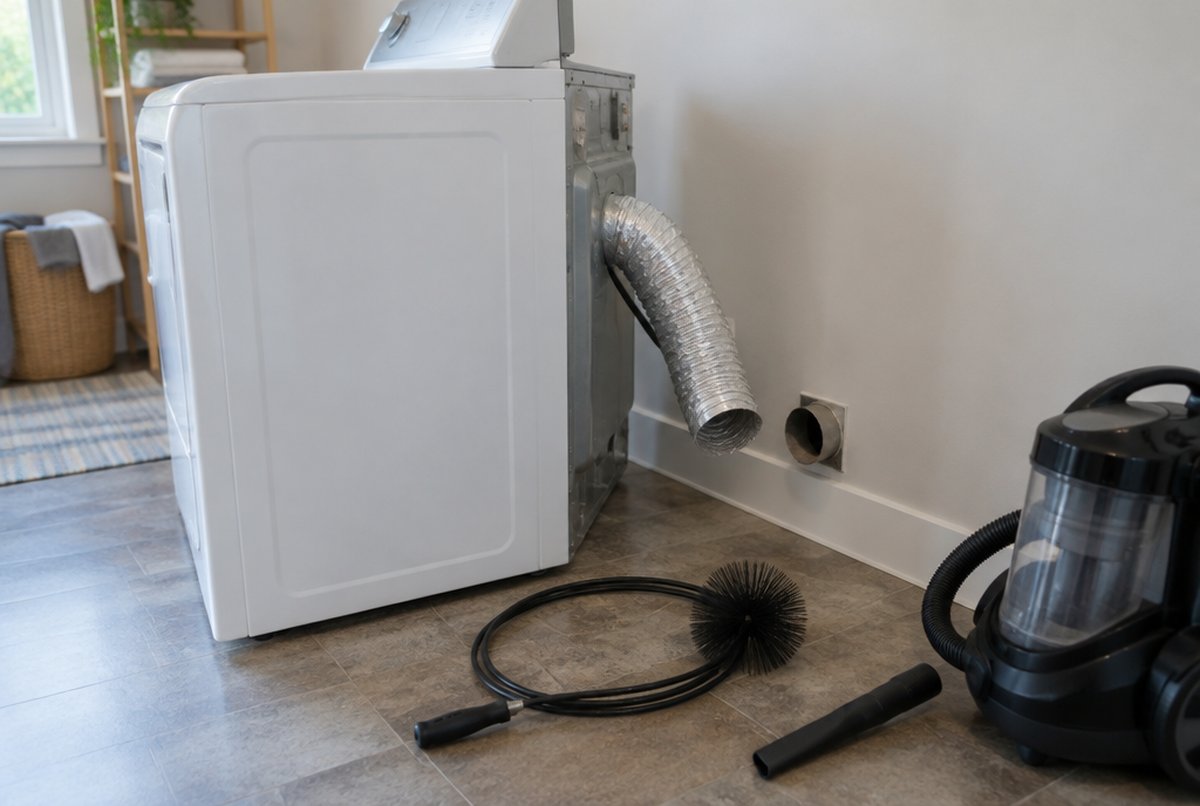
Yes, you can clean a dryer vent yourself when the duct is short, fairly straight and ends at a wall vent you can reach from the ground. A brush kit, a vacuum and about an hour will handle that. Call a professional when the run is long, climbs through an attic, ends at the roof, or the brush stalls partway. The NFPA lists failure to clean as the leading cause of home dryer and washer fires, at 29 percent, so the vent is worth the hour. If drying now takes two cycles, the dryer cabinet runs hot or you smell something burning, clean the vent before you run another load.
When doing it yourself makes sense
The job is realistic for a homeowner in one situation: the dryer sits against an exterior wall, the duct runs a few feet straight out, and the vent hood is at ground level or low enough to reach safely. That describes many older single-story homes in Plano, Carrollton and Richardson. In that setup you can reach every foot of the duct from one end or the other, and you can see what comes out.
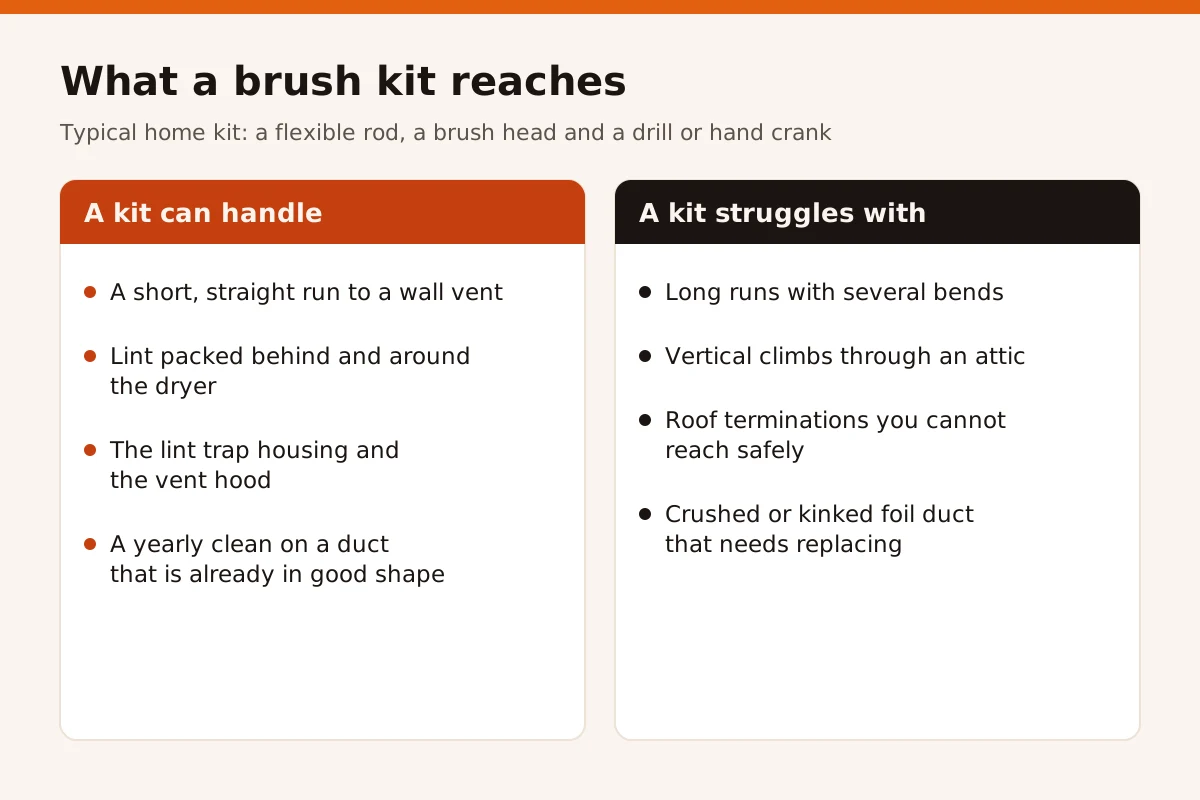
It gets harder fast from there. Each elbow is a place where lint packs in and where a brush has to bend around a corner. Newer two-story houses in Frisco, McKinney and Prosper often put the laundry room upstairs, which sends the vent up through the attic and out a roof cap. A kit can technically be pushed into that run, but you cannot see it, cannot tell what is left behind and would be working on a roof to check the far end.
What you need
A dryer vent brush kit is a round brush head on flexible rods that screw together, usually sold with an adapter so you can spin it with a cordless drill. You also need a vacuum with a hose and crevice tool, a screwdriver or nut driver for the duct clamps, foil tape rated for ducts and a bucket or trash bag for lint. A flashlight helps. Gloves and a dust mask are worth wearing, since the lint is fine and gets everywhere.
One thing to leave in the garage is the leaf blower. It pushes lint into joints and can blow a loose connection apart inside a wall.
The steps, in order
- Unplug the dryer. If it is a gas dryer, close the gas shutoff and stop here unless you are comfortable moving it without stressing the gas line.
- Pull the dryer forward far enough to reach the back. Do it slowly, since a crushed or kinked duct behind a dryer shoved against the wall is one of the most common causes of a slow dryer.
- Loosen the clamp and detach the duct from the dryer outlet and the wall. Vacuum the outlet on the dryer, the lint trap housing and the floor behind it.
- Go outside, remove or open the vent hood, and clear whatever you can see at the exterior end.
- Feed the brush into the duct from one end, turning it as you push, and pull it back out often to clear lint. Add rods as needed. Work from both ends if you can reach them.
- Vacuum the duct after brushing to pick up what the brush loosened.
- Reconnect with clamps or foil tape, not sheet metal screws that stick into the duct and catch lint. Push the dryer back without squashing the duct, then run it on air-only and confirm strong airflow at the hood outside.
What a kit does not reach
A brush on flexible rods cleans the surface of the duct it can travel through. It does not repair a duct that is crushed, sagging or full of low spots where lint settles, and it does not tell you how much is left on the far side of a bend. The rods also flex, so in a long run the brush stops being in any real contact with the duct walls.
Length matters for code as well as cleaning. The International Residential Code, as summarized by InterNACHI, caps a dryer exhaust run at 35 feet of developed length, minus 5 feet for each 90 degree bend and 2.5 feet for each 45 degree bend. A duct with three elbows has far less usable length than the tape measure suggests, and a long run with turns is exactly where a kit falls short. Ask your city which edition of the code it enforces if you are rebuilding a run.
The same summary says flexible transition ducts should be listed for the purpose, limited to 8 feet and not hidden inside walls, and that ribbed foil or plastic vent should not be used. If the duct behind your dryer is the ribbed kind, replace it with smooth rigid metal when you reconnect it.
Roof terminations and attic runs
If the vent leaves through the roof, the answer for most homeowners is to hire it out. The run is usually longer, it has a vertical section, and the cap on the roof is where birds nest and lint packs against the damper. Checking it means getting on a roof, which is a bigger risk than the lint. A technician can push a brush through with a rotating head, clear the cap and confirm airflow from the top. Our dryer vent cleaning service covers wall and roof terminations across DFW.
When to stop and call
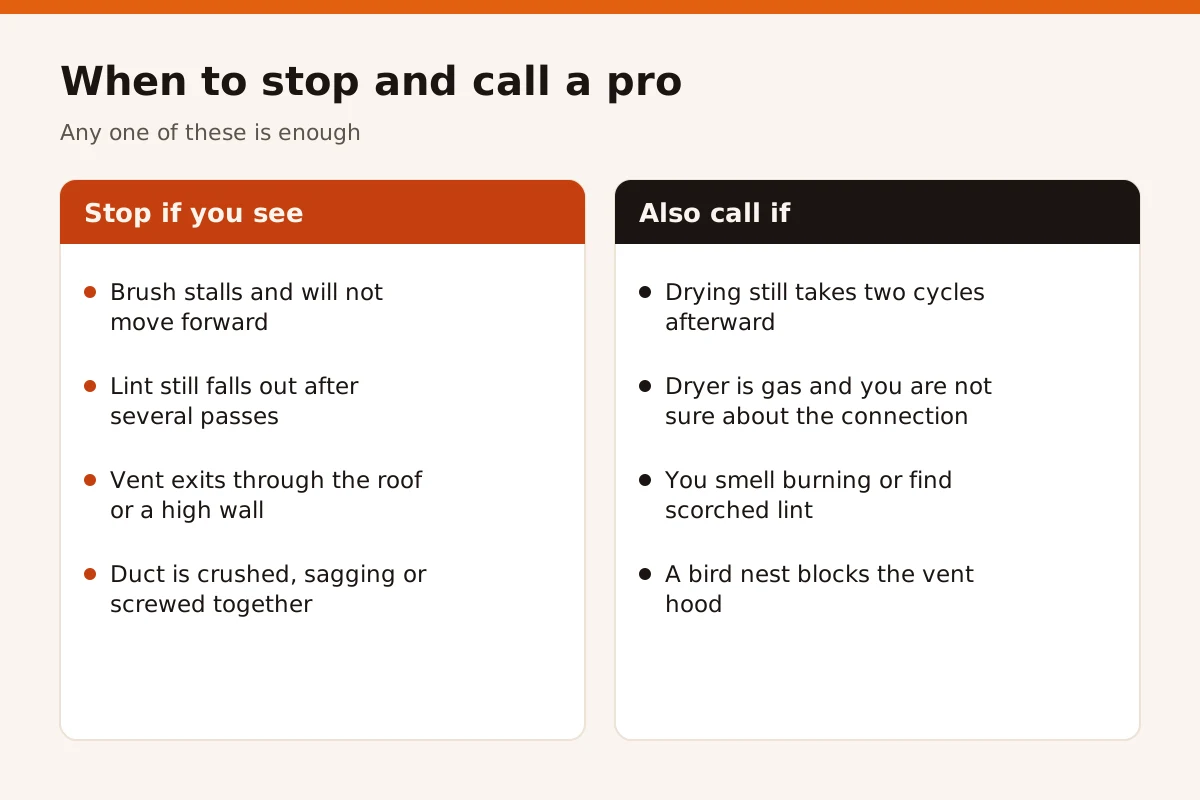
Stop and call a professional if the brush stalls and will not advance, if lint keeps falling out after several passes, if the duct is crushed or joined with screws, or if a bird nest blocks the hood. Call if your dryer is gas and you are unsure about the connection, and call if you find scorched or blackened lint, which means the dryer has already run hot.
How you know it worked
Run the dryer empty on air-only for a few minutes and hold your hand at the outside hood. You should feel a strong, steady push of air and the flap should open fully. Then dry a normal load. If it finishes in a single normal cycle, the vent is doing its job. If it still takes two cycles, something is left in the duct or the duct itself is the problem. Our guide to the signs of a clogged dryer vent lists what to watch for afterward.
How often to repeat it
Clean the lint trap after every load and the vent at least once a year, more often for a big household or a long run. Our guide on how often to clean a dryer vent goes through the schedule by household size and vent type. The fire data explains why it is not optional. The NFPA figures, covering dryers and washers combined, put failure to clean at 29 percent of home fires in that category, well ahead of every other single cause.
What a professional visit costs
If you decide to hire it out, national figures from HomeAdvisor put a ground-floor wall vent at roughly $80 to $150, a second-floor wall vent at $110 to $185 and a roof termination at $150 to $250. Our dryer vent cleaning cost guide explains what moves a quote. Compare that with an hour of your time, a kit and the chance you still need someone to finish it.
Not sure your vent is a DIY job?
We clean wall and roof dryer vents across DFW and check airflow when we finish. Based in Plano, working across DFW since 2013. Call or ask for a visit and we will tell you plainly whether your vent is worth a trip.
Common questions about cleaning your own dryer vent
Is it safe to clean a dryer vent yourself?
It is safe on a short, straight wall vent if you unplug the dryer first. Leave gas dryers, roof vents and long runs with bends to a professional.
What do I need to clean a dryer vent?
A brush kit with flexible rods, a vacuum with a hose and crevice tool, a screwdriver for the clamps, foil tape and a flashlight. A cordless drill speeds up the brushing.
How long does it take to clean a dryer vent yourself?
Plan on about an hour for a short, straight wall vent. A long run or a stubborn blockage takes longer or needs a technician.
Can I use a leaf blower to clean a dryer vent?
We would not. It packs lint into the joints and can push a loose connection apart inside the wall. Use a brush and a vacuum.
How do I know if my dryer vent is clean afterward?
Run the dryer on air-only and feel the airflow at the outside hood. It should be strong and steady, and a normal load should finish in one cycle.