
How to Choose a Chimney Sweep: What CSIA Certification Means
The credential to check, the questions that separate a real chimney company from a truck with a ladder, and the red flags worth walking away from.
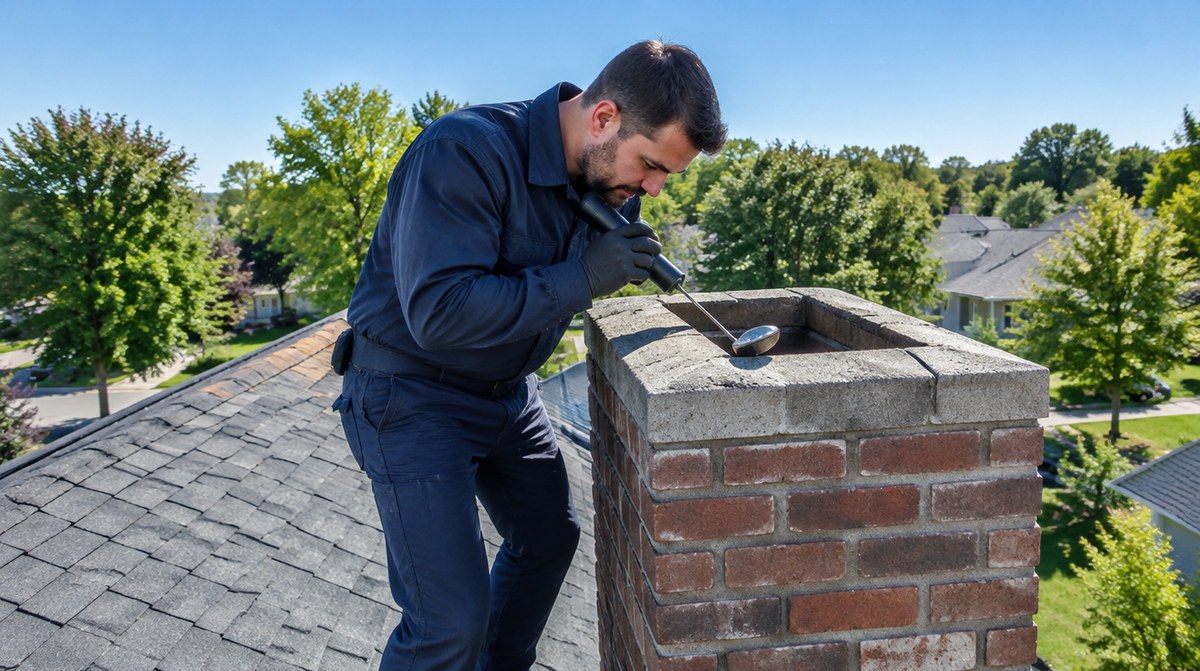
CSIA certification means a technician has passed a written exam on chimney and venting systems administered by the Chimney Safety Institute of America, a nonprofit group, and agreed to ongoing education to keep that credential active. It matters more in Texas than it would in a licensed trade, because the state does not license chimney sweeps at all, so a CSIA card is the closest thing this industry has to a required standard. Passing the exam does not guarantee a flawless job on your specific chimney, but it does mean the technician has demonstrated real knowledge of clearances, draft, creosote behavior and fire code, not just how to run a brush up a flue. Before you book anyone, ask for the certification number, verify it directly at csia.org, and pair that check with proof of insurance and a written, itemized quote.
Why "certified" carries more weight in a state with no license
Plenty of trades in Texas require a state license before anyone can legally take your money for the work: electricians, plumbers, HVAC technicians. Chimney sweeping is not one of them. There is no Texas license for chimney sweeps, no state board that tests applicants, and no state agency that revokes a bad operator's right to work. Anyone with a truck, a brush and a website can call themselves a chimney company.
That gap is exactly what certification exists to fill. It will not stop a bad operator from printing a certification logo they do not actually hold, but it gives you something concrete to check instead of taking a truck decal or a five-star homepage at face value. A real certification comes from a real organization, with a real number attached to a real person, and that number is checkable in about thirty seconds.
What the CSIA exam actually tests
The Chimney Safety Institute of America is the group behind the certification homeowners run into most often. To earn it, a technician sits a written exam covering chimney and venting systems: how clearances to combustible material work, how creosote forms and progresses through its stages, how draft depends on flue size and height, and how the National Fire Protection Association's chimney standard, NFPA 211, applies to inspection and repair work. Passing requires studying real material, not filling out a form.
Certification also is not a one-time event. CSIA requires continuing education to keep the credential current, which means an actively certified technician is expected to keep up with changes to code and best practice rather than coasting on an exam passed a decade ago. What the exam does not do is inspect that specific company's trucks, verify their insurance, or grade the quality of a job they finished last week. It tests knowledge, not a track record.
NFI and NCSG: the other credentials you will see quoted
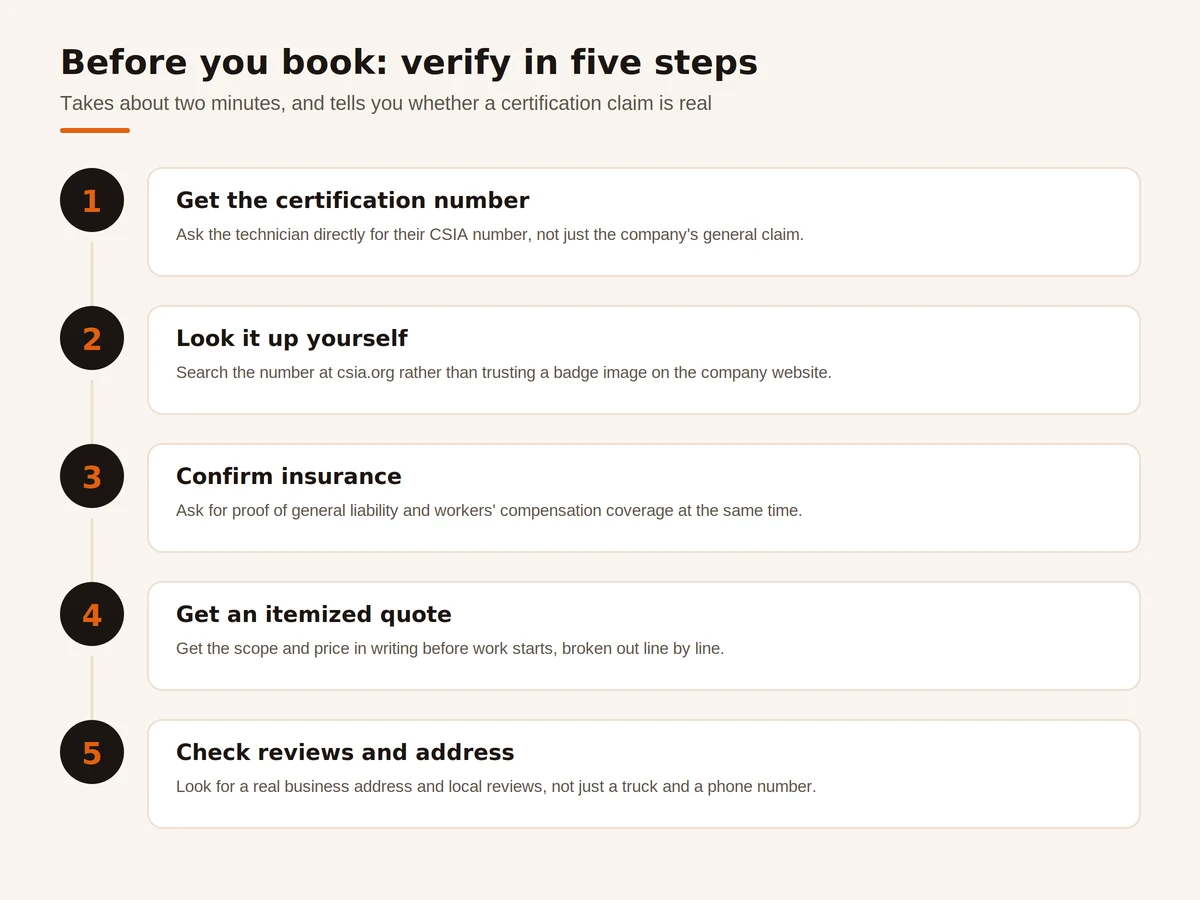
CSIA is not the only badge that shows up on a chimney company's website, and the differences between them matter more than the logos suggest. The National Fireplace Institute certifies technicians on hearth appliances specifically, wood stoves, gas fireplaces, pellet inserts, rather than the chimney and venting system as a whole. A company doing both fireplace repair and chimney sweeping ideally holds both credentials, since they cover different parts of the job.
The National Chimney Sweep Guild is different again. It is a trade association, not a pass or fail exam, so membership signals industry involvement, access to training and events, and a stated commitment to standards, but it is not proof that any individual technician passed a knowledge test. The EPA's Burn Wise program, which some companies also list, is an outreach and education initiative around cleaner wood burning practices, not a personal license either. None of these are meaningless, but they answer different questions, and a company that only lists one should not be read as covering the ground all four cover together.
How to verify a certification before you book
A logo on a website costs nothing to add and nothing to fake. Verifying it costs about a minute and tells you whether it is real.
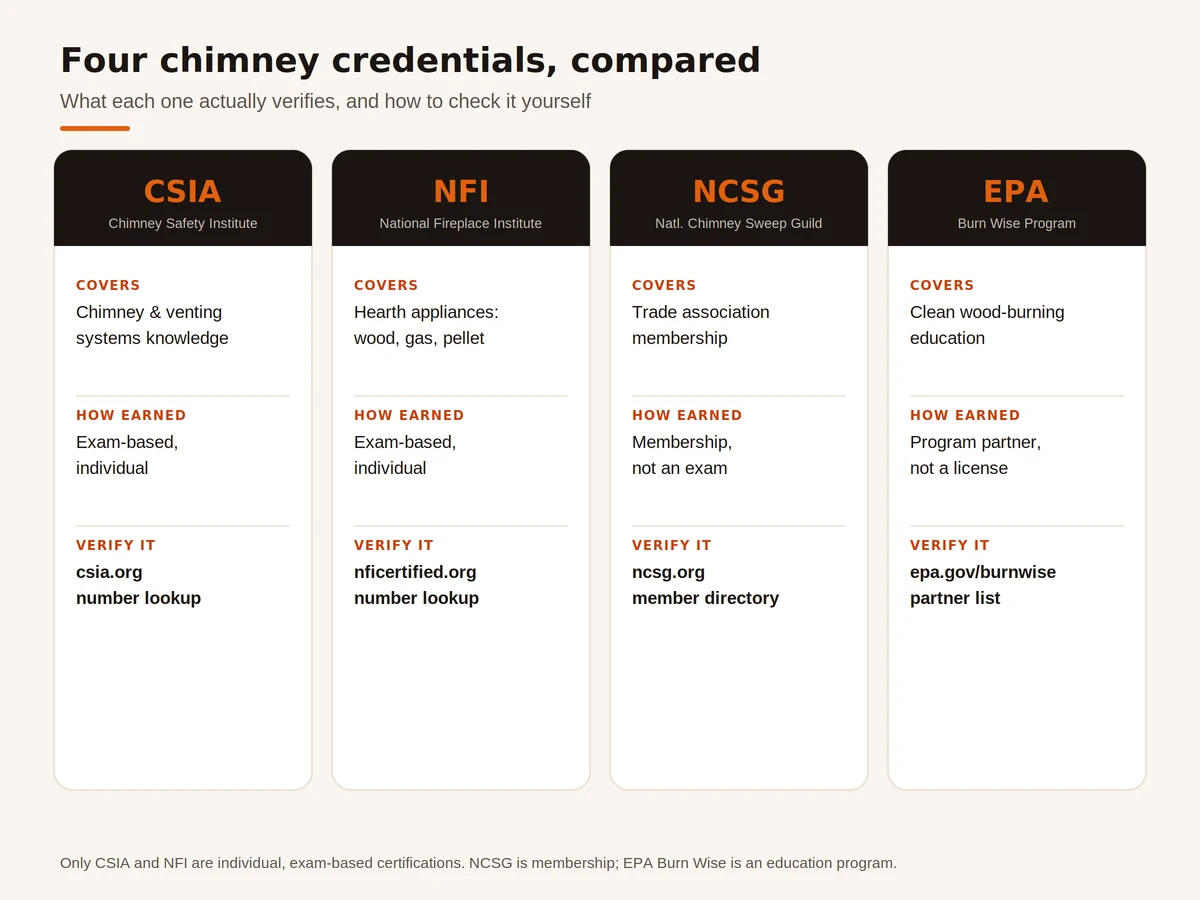
- Ask for the technician's CSIA certification number directly, not just the company's general claim of being "certified."
- Look that number up yourself at csia.org rather than trusting a screenshot or a badge image on the company's own site.
- Confirm the certified individual is still an active technician at that company, since certifications belong to people, not businesses, and staff turns over.
- Ask for proof of general liability insurance and workers' compensation coverage at the same time, since a certification with no insurance behind it still leaves you exposed if something goes wrong on your roof.
- Get the scope and price in writing before work starts, itemized enough that you know what a follow-up repair would cost if the inspection finds one.
Six questions worth asking beyond "are you certified"
Certification is a filter, not the whole interview. These six questions do more to separate a company that will do right by your chimney from one that will not.
- Will you show me what you find? A technician who photographs the flue before and after, and shows you the images rather than just describing what they saw, is giving you something to verify.
- Is the estimate itemized? A single lump number makes it hard to tell what you are actually paying for, or to compare against a second quote line by line.
- Do you carry general liability and workers' comp? If a technician is hurt on your roof and the company has no workers' comp, the liability can land on you as the property owner.
- Who does the actual work? Some companies subcontract sweeps and repairs out to whoever is available that week. Ask whether the person on your roof is an employee or a sub.
- What is included in the quoted price? A basic sweep and a full Level 2 video inspection are different services. Know which one you are booking before the truck shows up.
- What happens if you find something mid-job? A company with a clear answer, stop and call you with photos and a price before proceeding, is set up to respect your budget rather than surprise you with it.
Red flags that mean walk away
A few patterns show up again and again in complaints about bad chimney work, and any one of them is reason enough to call someone else.
- An unsolicited knock on the door, especially right after a storm, offering an inspection today only.
- Pressure to sign or pay before you have had time to check a certification number or read a single review.
- No fixed business address and no landline tied to an established company, only a cell number and a magnetic truck sign.
- Insistence on cash only, with no invoice or receipt offered.
- A certification number that does not match anyone in the issuing organization's directory when you check it yourself.
- A refusal to show photos or put findings in writing before asking you to approve repair work.
What this looks like in practice
We are not neutral on this topic, so judge the claim the same way we are telling you to judge anyone else's: check it. Our chimney technicians are CSIA certified, NFI certified, EPA Burn Wise certified and members of the National Chimney Sweep Guild, and we are BBB A+ rated. You can read more about how we work and what those credentials cover on our about page, and see what actual DFW homeowners say after the truck leaves on our testimonials page. Every visit starts with a free inspection and photos before anything is quoted, and the crew that shows up is our own, not a subcontractor.
None of that is a substitute for doing the thirty seconds of verification described above, on us or on anyone else you are considering. A homeowner who checks the number, asks the six questions and watches for the red flags will end up with a better chimney company than one who books whoever calls back first, regardless of which company that turns out to be.
Want a certified technician on your roof this week?
Free inspection, photos of what we find, and an itemized quote before anything gets touched. Based in Plano, working across DFW since 2013.
Common questions about chimney sweep certification
Is CSIA certification legally required for chimney sweeps in Texas?
No. Texas does not license chimney sweeps at all, so no certification is legally required to do the work. CSIA certification is a voluntary industry standard, not a state mandate, which is exactly why checking for it matters more here than in a state that already screens contractors through licensing.
What is the difference between CSIA and NFI certification?
CSIA certification covers chimney and venting systems broadly: clearances, draft, creosote and code. NFI certification focuses specifically on hearth appliances such as wood stoves, gas fireplaces and pellet inserts. A company that does both sweeping and appliance repair ideally holds both, since they test different knowledge.
How do I check if a chimney sweep's certification is real?
Ask for the certification number directly, then look it up yourself at csia.org rather than trusting a logo on the company website. The lookup takes under a minute and confirms whether that number belongs to an actively certified technician.
Does hiring a CSIA certified sweep cost more?
Not necessarily. Certification is a knowledge credential, not a pricing tier, and plenty of certified companies price in line with the local market. Treat certification as a screening step alongside insurance and reviews, not as the reason a quote is higher or lower.
Is NCSG membership the same as being certified?
No. The National Chimney Sweep Guild is a trade association that a company or technician joins, not an exam anyone has to pass. Membership can signal genuine industry involvement, but it is not proof of the same tested knowledge that a CSIA or NFI certification represents.